This set of 20 free printable number tracing worksheets takes kids from 1 to 20, one number per sheet. Every sheet works the same friendly way: color the big outline numeral, count and color the matching set of pictures (apples, flowers, balloons, hearts, and stars), trace the dotted number down two guided rows, write it all on your own, and trace the number word at the bottom. It is a complete little lesson on one page, made for preschool, kindergarten, and early first grade — at home, in the classroom, or in a homeschool binder. Each worksheet has its own page with Download and Print buttons, so you can print a single number or the whole set.
About These Number Tracing Worksheets
Every sheet in this set follows the same learning path, and the repetition is the point. Kids meet the number big first and color it in, then trace it down two dotted rows where a solid model at the start of each row shows exactly how it is formed, and only then write it alone on the blank write-it-yourself row. Going from guided to independent on a single page builds the stroke order into muscle memory, and the number word waiting at the bottom ties the symbol to its name.
The count-and-color panel is where the number stops being a shape and starts being an amount. Children count the pictures one at a time and color each one as they go, so nothing is counted twice and nothing is skipped; the last number they say is how many there are, which is the heart of early number sense. The panels grow from a single star to twenty apples across the set, and from eleven onward the pictures settle into rows of five, so older preschoolers and kindergarteners can start counting in groups — five, ten, fifteen, twenty.
Get new coloring pages sent to your inbox!
Sign up and get our free 10-page Printable Favorites pack.
All 20 Number Tracing Worksheets 1–20
Scroll down to browse every page below, or use the Print button under any image to print just that page.
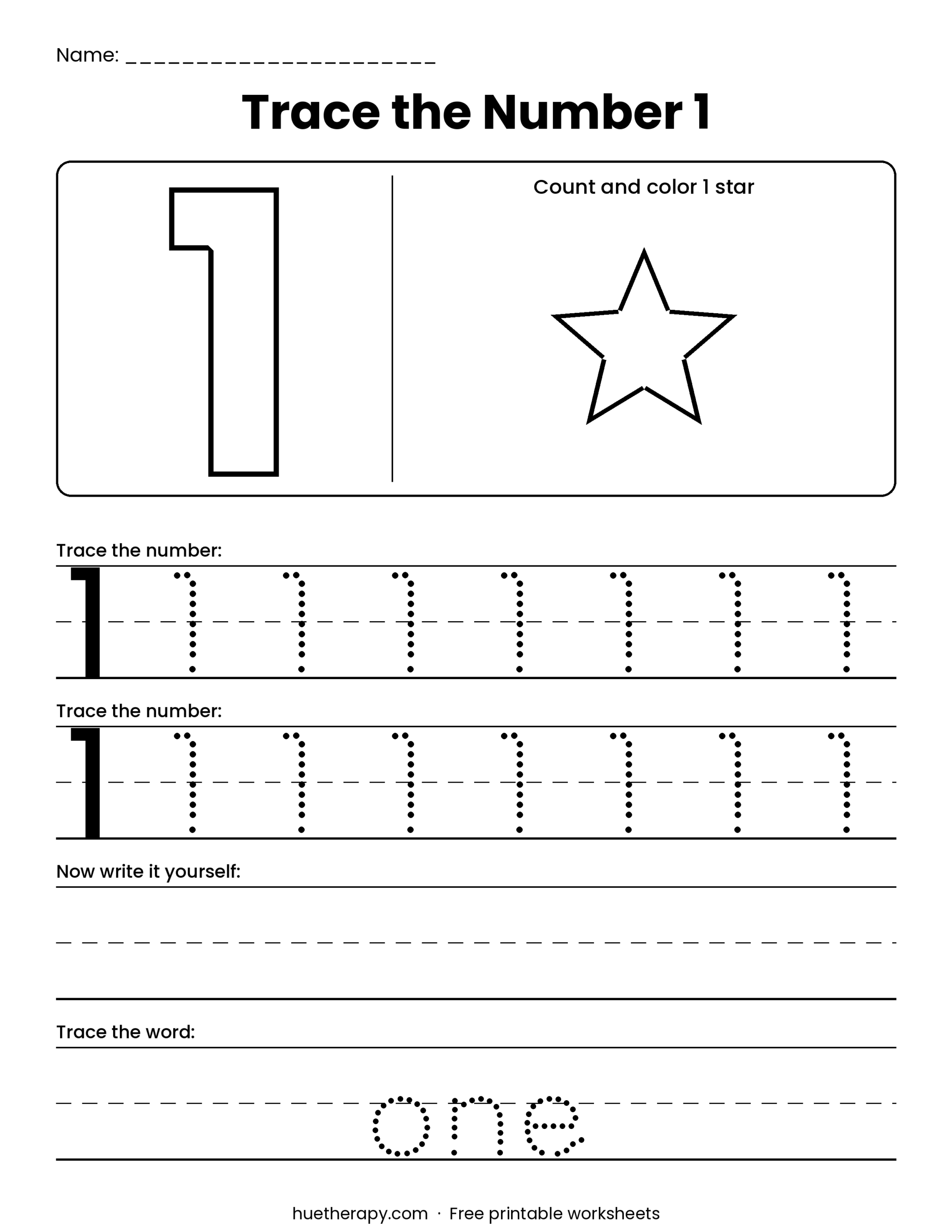
Number 1 — one. The set starts with the simplest sheet of all: a big outline 1 to color and a single star in the count-and-color panel. Kids trace the straight 1 down two dotted rows, write it on their own, and finish by tracing the word one.
One is the friendliest first number: a single straight line pulled down from the top, and both tracing rows repeat that same simple path. In the count panel there is just one star to color, which teaches the biggest idea of all — counting ends somewhere, and the last word you say tells how many. Point at the star, say one, and color it in.
Extension: after the sheet, go on a one hunt — one nose, one front door, one sun in the sky. Back at the table, draw one more star in the margin and color it a different color, then say the counting words for the page out loud: one star on the sheet, one star of your own.
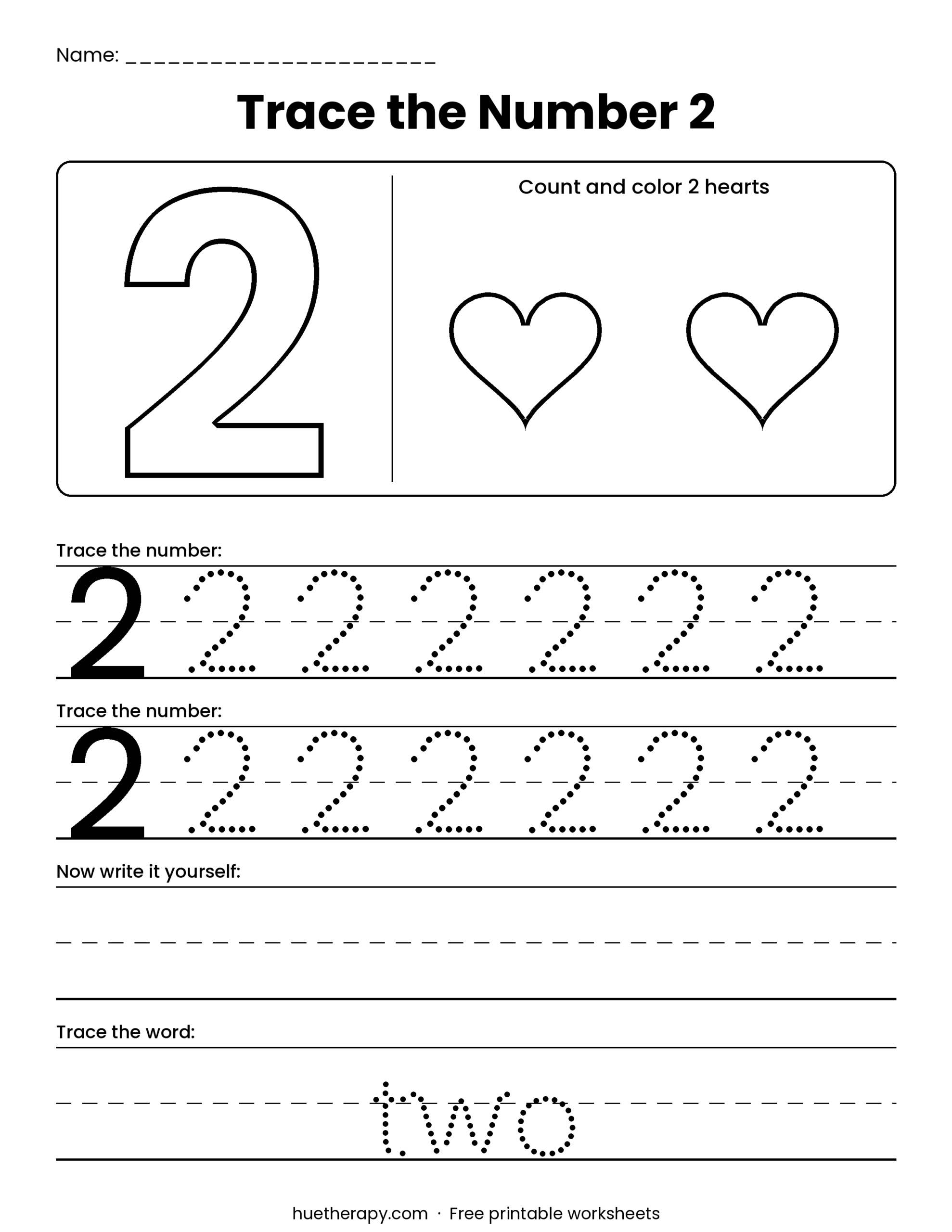
Number 2 — two. A big swan-necked 2 to color, with two hearts waiting in the count-and-color panel. Two guided tracing rows build the around, down, and across path before the free-writing row, and the word two is traced at the bottom.
Two has the most movement of the early numbers: a curve across the top like a swan's neck, a long slide down to the left, then a straight line across the bottom. Say around, down, and across while tracing to lock in the path. The count panel holds two hearts in one row, an easy left-to-right count of one, two.
Extension: two is the number of pairs, so hunt for them — two shoes, two mittens, two socks from the laundry basket. Then draw two extra hearts in the margin, one big and one small, and count the hearts on the whole page: two printed plus two drawn makes four.
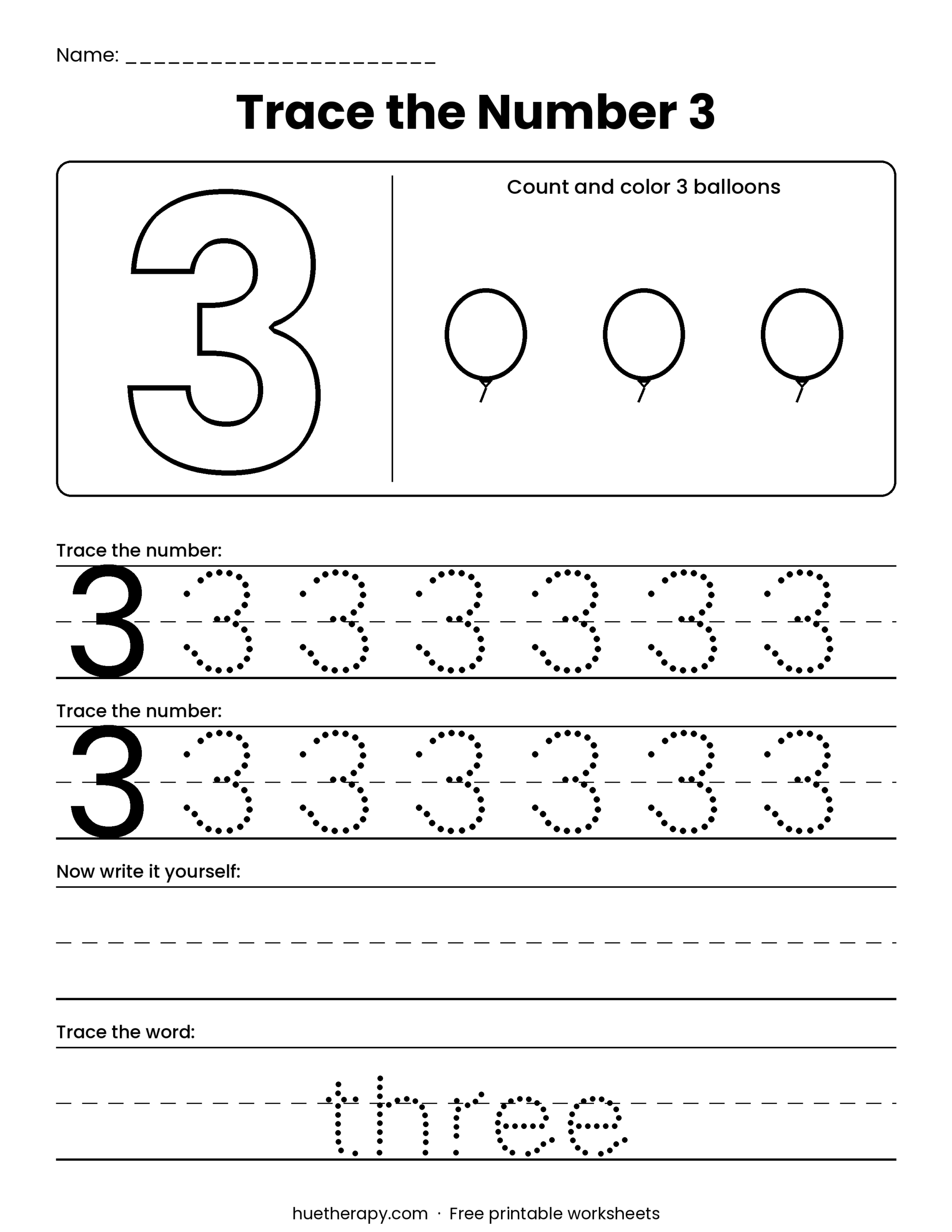
Number 3 — three. The big double-curved 3 comes with three balloons to count and color. Trace the 3 down two dotted rows, write it solo on the blank row, and trace the word three to finish the sheet.
Three is two curves stacked on top of each other, a smaller one above and a rounder one below — little curve, big curve is a handy chant while tracing. Watch that the middle point comes back to the center line, which keeps a 3 from looking like a sideways W. Three balloons sit in a single row, a tidy one-two-three count.
Extension: balloons beg for strings, so draw three wavy strings hanging from the printed balloons and a hand holding them at the bottom. Then count things in threes around the room — three claps, three jumps, three books pulled off the shelf and stacked.
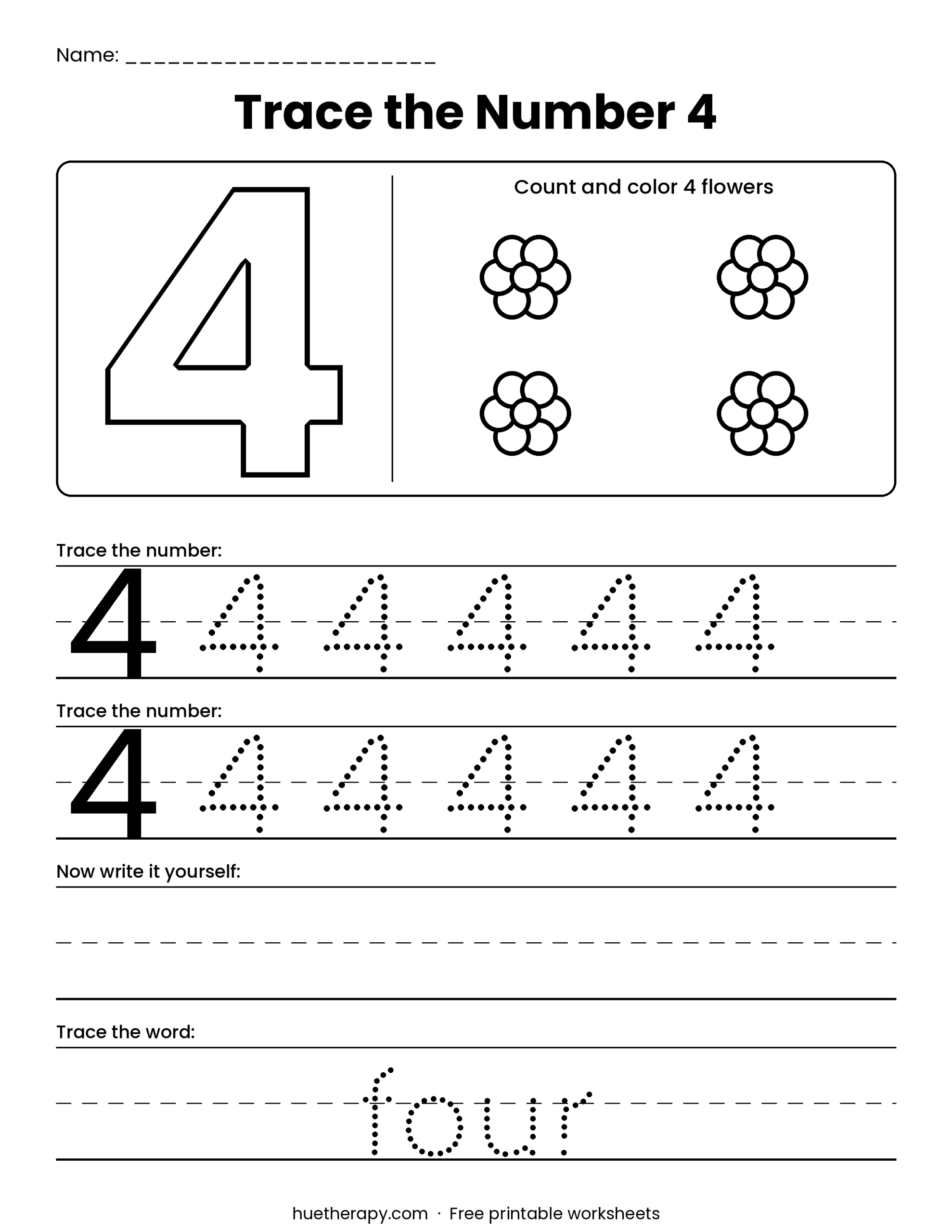
Number 4 — four. A pointy, all-straight-lines 4 to color, and four flowers arranged in a tidy two-by-two square to count. Two rows of tracing, one row of independent writing, and the word four traced at the bottom.
Four is all straight lines and sharp corners: down, across, then one tall line that drops right through the crossbar. Three separate strokes make it a good first lift-your-pencil number. The panel arranges four flowers in a two-by-two square, so kids can count across the top row and then the bottom row — one, two, three, four.
Extension: fours hide everywhere — four legs on a chair, four legs on a table, four wheels on a car. Pick one and count its legs or wheels out loud. Then draw four more flowers with stems and grass underneath to turn the panel into a flower box of eight.
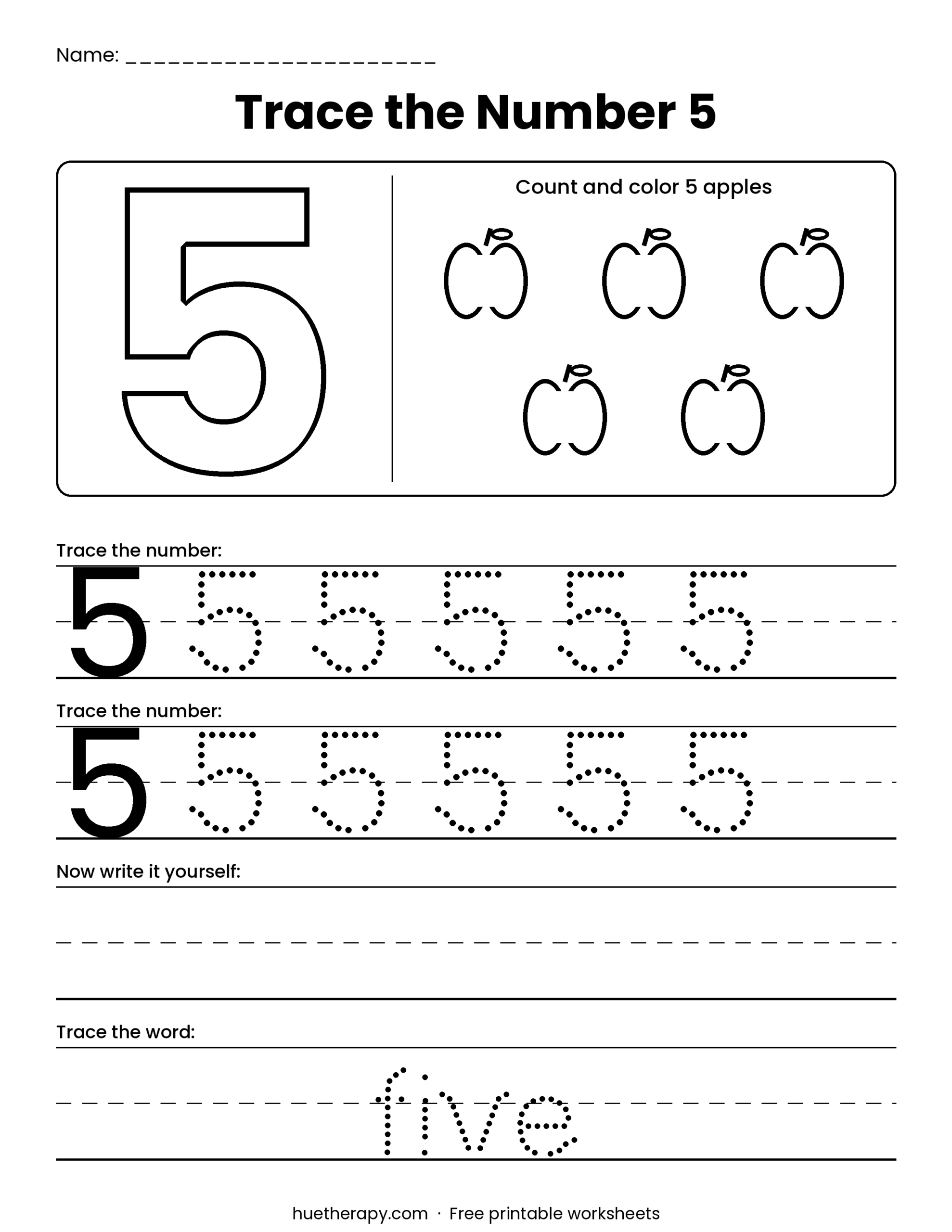
Number 5 — five. The flat-topped 5 gets five apples to count and color, in rows of three and two. Kids trace the 5 down both dotted rows, write it themselves, and trace the word five.
Five has three parts: a flat hat across the top, a short line down, and a big round belly. The flat top is the anchor — starting there stops the common backwards 5. Chant hat, down, and around. The five apples sit in two short rows of three and two, which gives an early taste of counting in groups rather than one by one.
Extension: five is one whole hand, so trace a hand next to the sheet and count its five fingers. Then draw five more apples up in a tree — the rows on the sheet plus a tree of five makes ten apples to count all together.
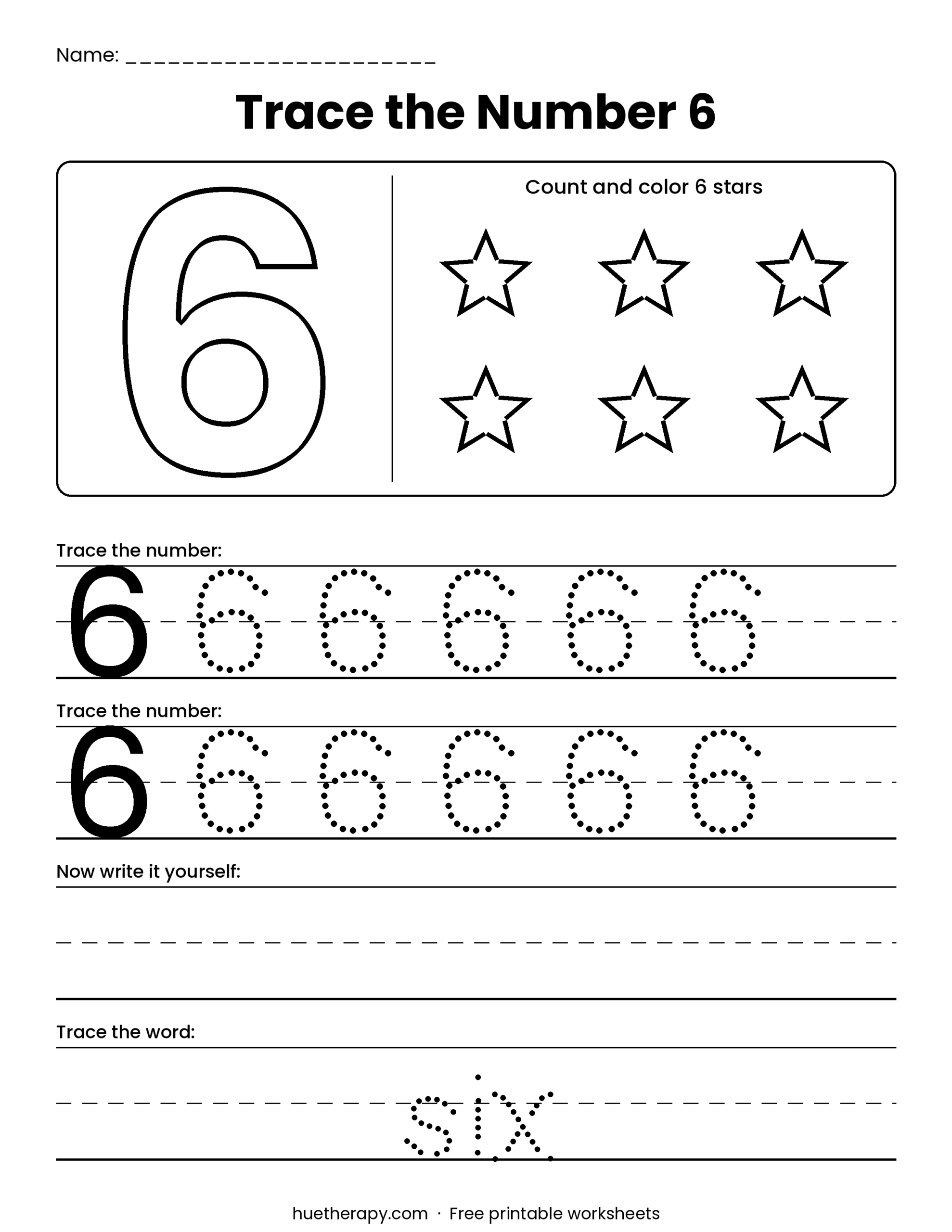
Number 6 — six. One flowing, loopy 6 to color, with six stars in two rows of three for the count panel. Trace it, write it yourself, and trace the word six — and watch that the loop stays at the bottom.
Six is one flowing line: start near the top, curve around, and close a full round belly at the bottom. It is the mirror trickster of this set — if the loop lands at the bottom, it is a 6; kids who flip it are already halfway to 9. Six stars form two neat rows of three, an easy count across and down.
Extension: roll a die or count six crayons out of the box and line them up beside the sheet. Then draw a night sky in the margin — a crescent moon and six tiny stars of your own — and count every star on the page, printed and drawn alike.
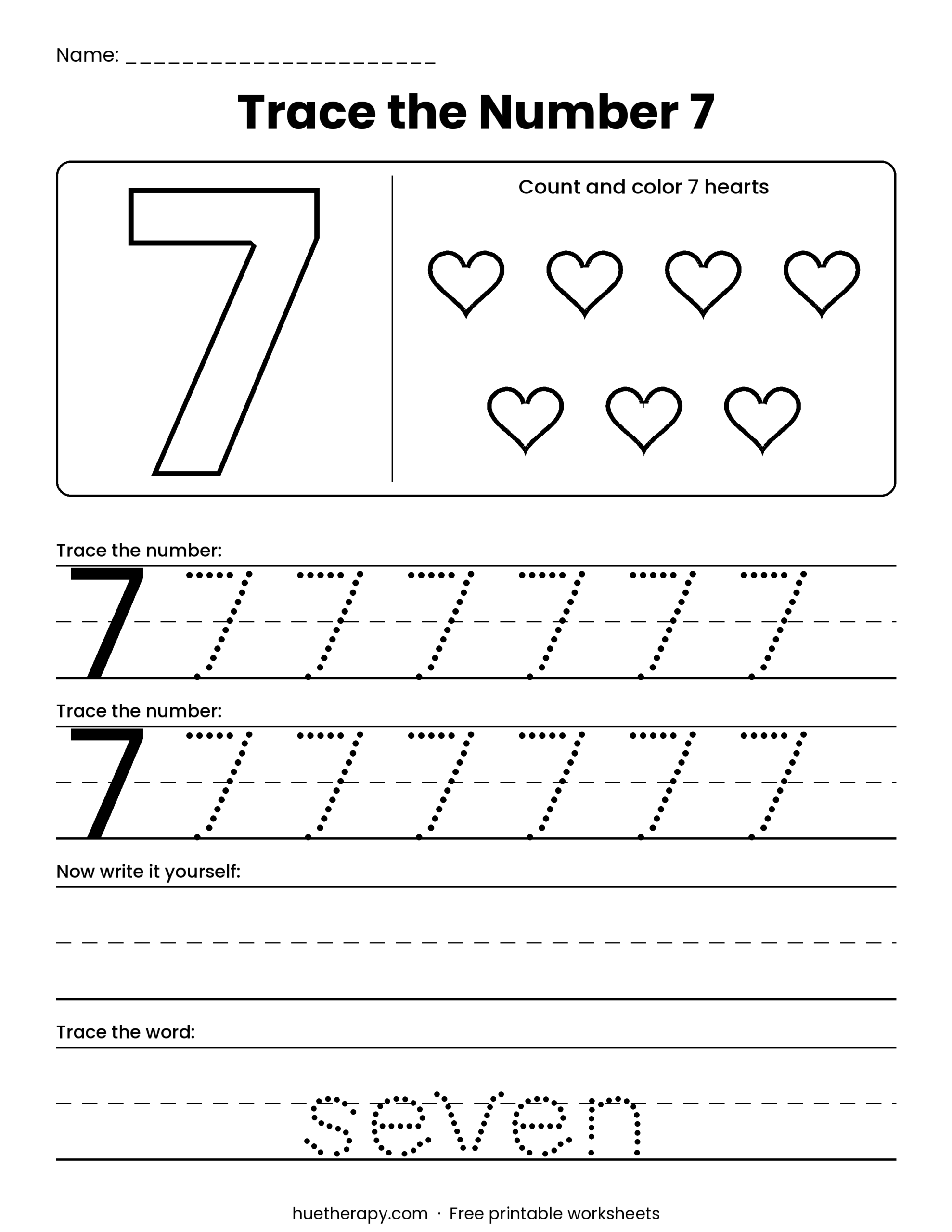
Number 7 — seven. An all-straight-lines 7 to color and seven hearts, four over three, to count and color. The diagonal stroke gets two full tracing rows before the free row, and the word seven closes the sheet.
Seven is two straight strokes: a flat line across the top, then one long diagonal slide down to the baseline. No curves at all, which makes it fast and satisfying to trace. Because the diagonal leans, remind writers to start at the top corner every single time. Seven hearts are laid out four over three, so counting crosses into a second row midway through.
Extension: seven is the days of the week, so point to a calendar and count the seven days in one row. Then draw seven more hearts trailing up the margin like a garland, and count the sheet's hearts and your hearts together — fourteen in all.
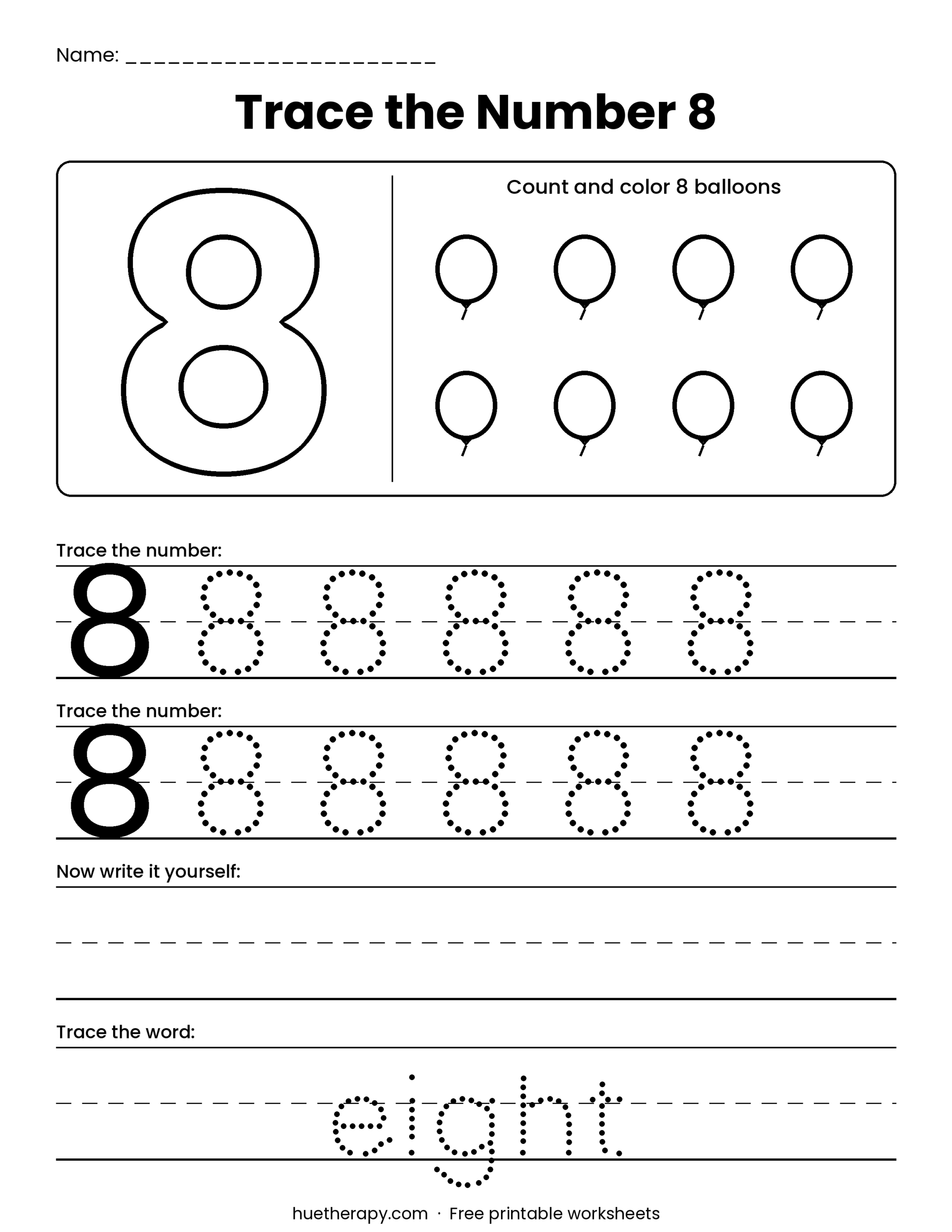
Number 8 — eight. The snowman-shaped 8 to color, with eight balloons in two rows of four. This is the hardest digit to form, so the two tracing rows really matter — then the solo row and the word eight.
Eight is the trickiest single digit: one continuous path that loops a small circle on top and a bigger circle underneath, crossing in the middle like a snowman. Starting at the top center and saying loop and loop helps the pencil keep moving without lifting. The eight balloons sit in two rows of four, ready for a first try at counting by twos.
Extension: spiders are the eight experts — draw a friendly spider in the margin and count its eight legs one by one. Then give the eight balloons on the sheet eight different patterns: stripes, dots, zigzags, and checks, so coloring them becomes a second counting game.
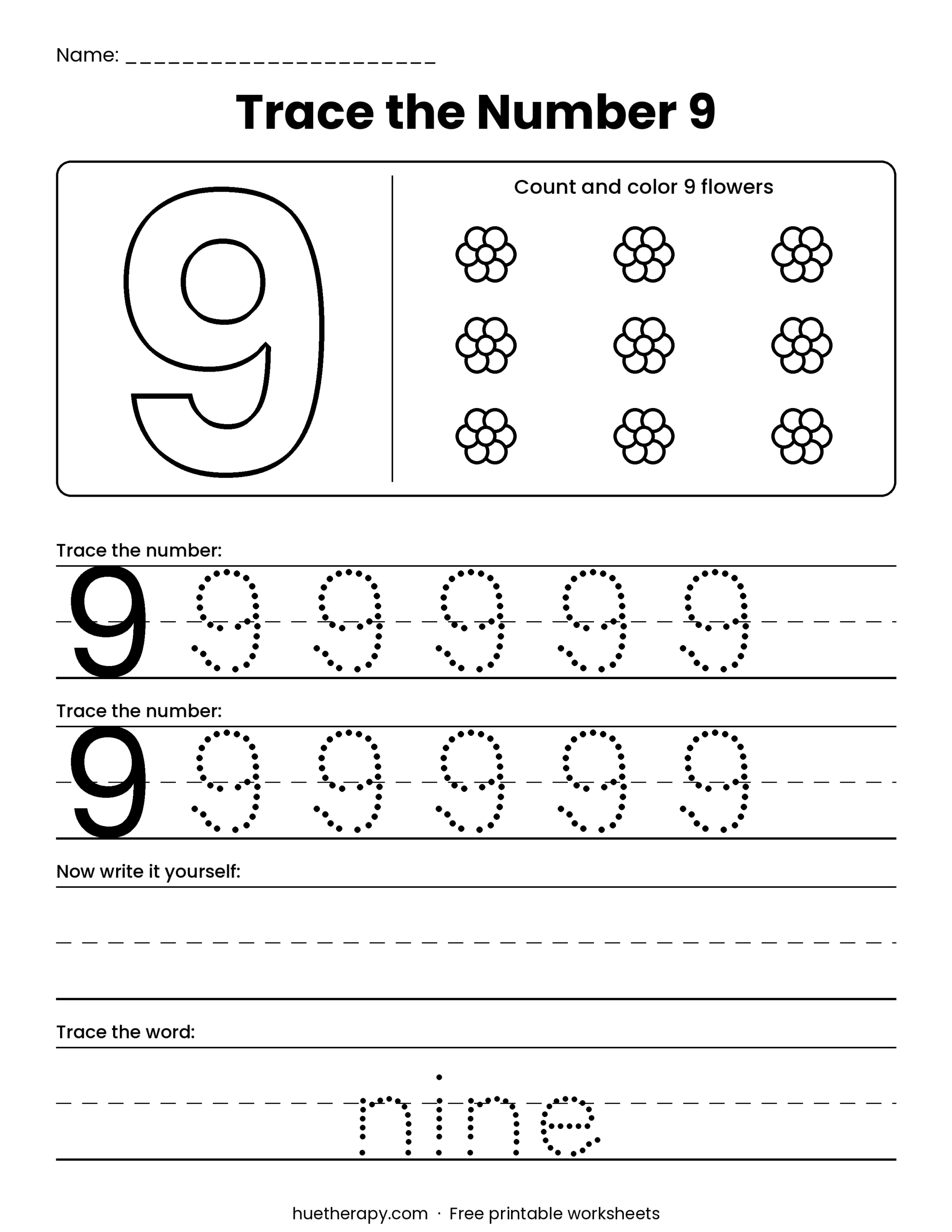
Number 9 — nine. A circle-topped 9 to color and nine flowers in a perfect three-by-three square to count. Two dotted rows of tracing, a write-it-yourself row, and the word nine at the bottom.
Nine is a round circle sitting on top with a straight tail that drops to the baseline — a circle and a line. It is 6 flipped upside down, so the tell is where the loop lives: top means 9. Nine flowers fill a perfect three-by-three square, the most satisfying grid in the whole set to count row by row.
Extension: plant a margin garden — draw nine more flowers in a row with stems and leaves under the printed panel. Then play one less: nine flowers on the sheet, and if one gets picked, eight remain. Counting backwards from nine is a gentle first step down the number line.
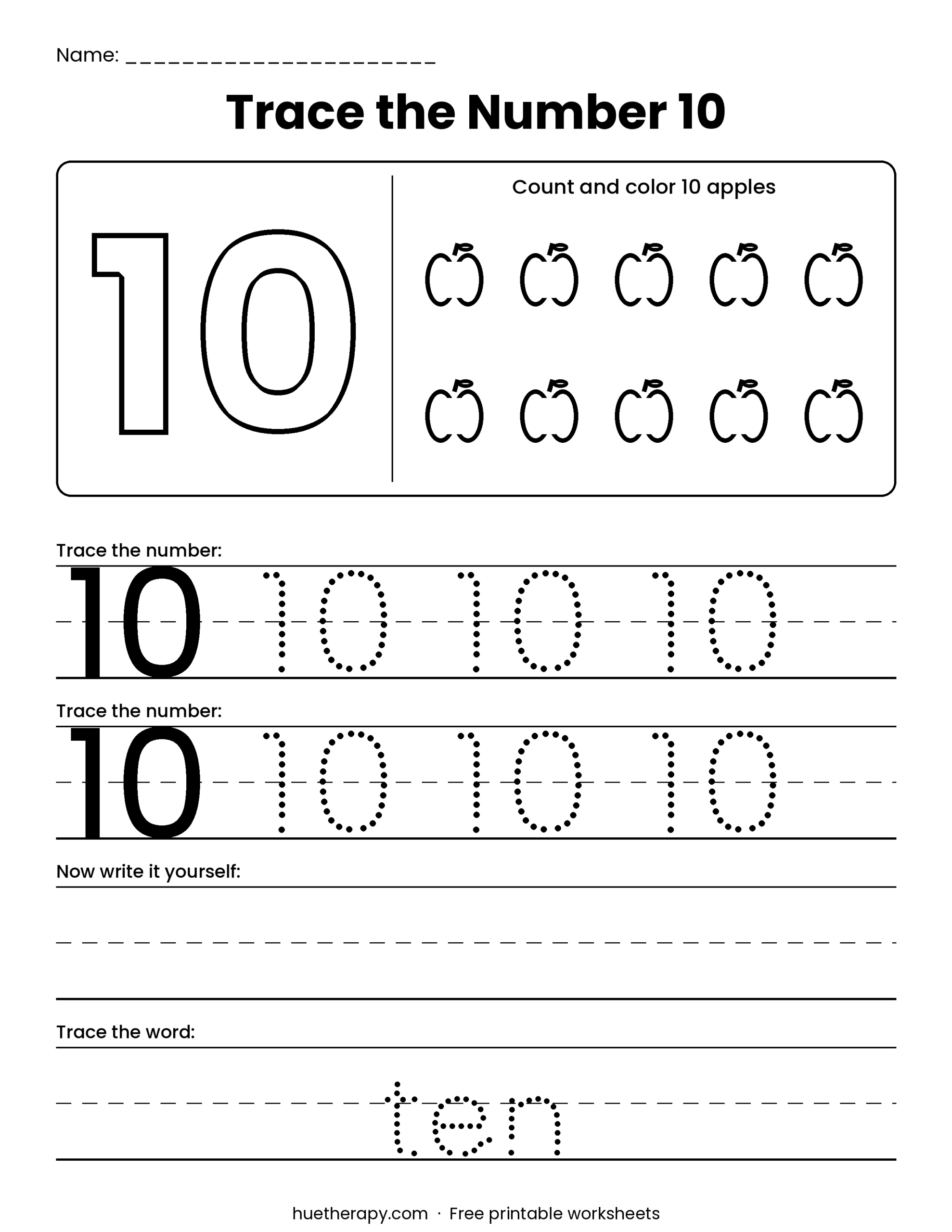
Number 10 — ten. The first two-digit number: a tall 1 and a round 0 to color, with ten apples in two full rows of five. Trace 10 down both dotted rows, write it alone, and trace the word ten.
Ten is the first two-digit number: a tall straight 1 and a round 0 standing side by side, both the same height. The tracing rows slow down here, and that is the point — two shapes, two starting points, one number. Ten apples fill two full rows of five, so kids can count 5, 10 by groups or go one by one.
Extension: ten is two hands — hold up all ten fingers, wiggle them, and count them twice. Then draw ten more apples in a basket in the margin and count the harvest: ten on the sheet plus ten in the basket makes the next big number, twenty.
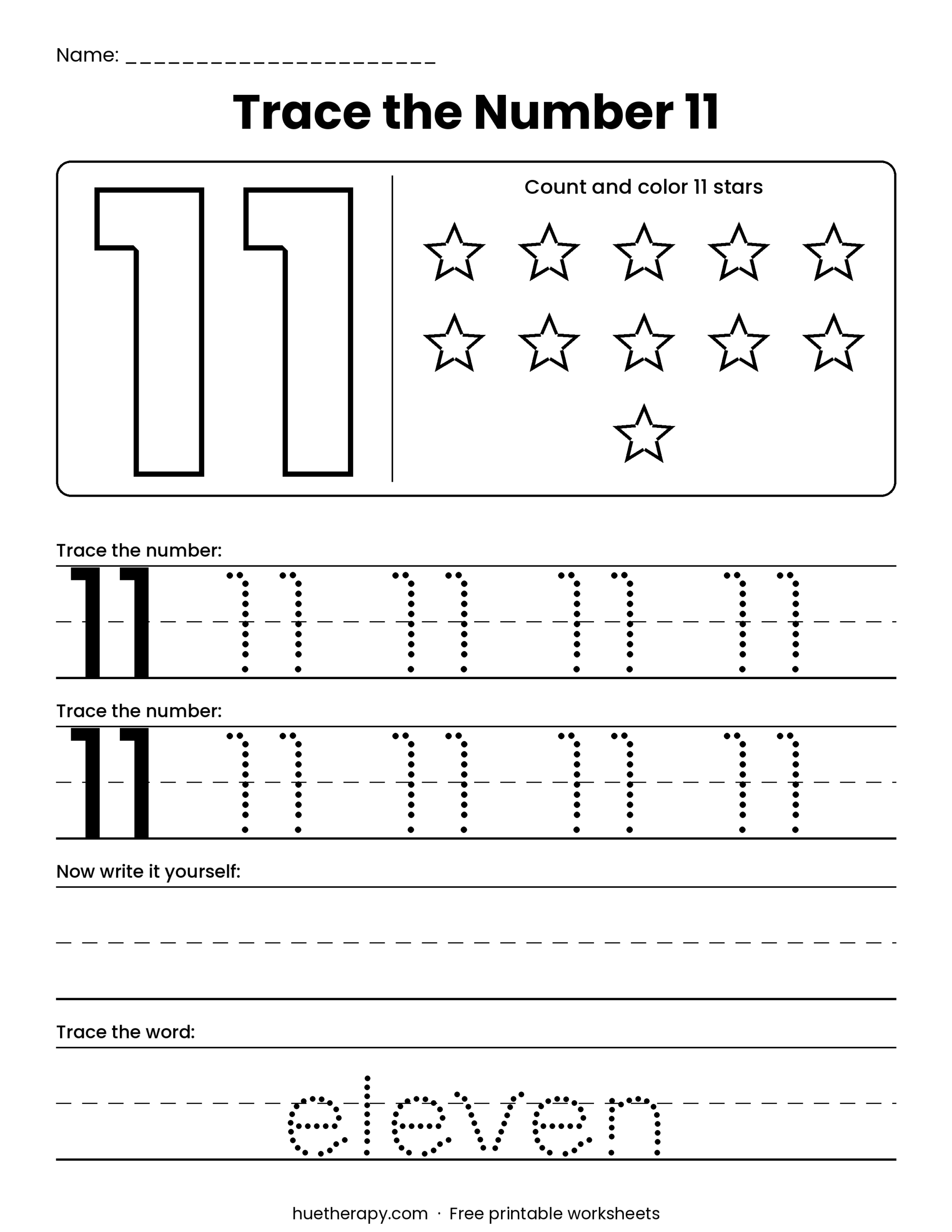
Number 11 — eleven. The same easy 1 written twice, with eleven stars to count and color — two rows of five and one more. A gentle first teen: trace, write, and finish with the word eleven.
Eleven is the friendliest teen: the same straight 1 written twice, with a little space in between. After the work of 10, this sheet is a confidence builder — two easy lines, done. The eleven stars come in two rows of five with one left over, the first clear picture of ten and one more, which is exactly what 11 means.
Extension: count out eleven of anything small — eleven blocks, eleven beans, eleven steps across the room. Then draw one extra star in the margin and ask the key question: eleven stars were printed, and one more makes how many? That answer, twelve, previews the next sheet.
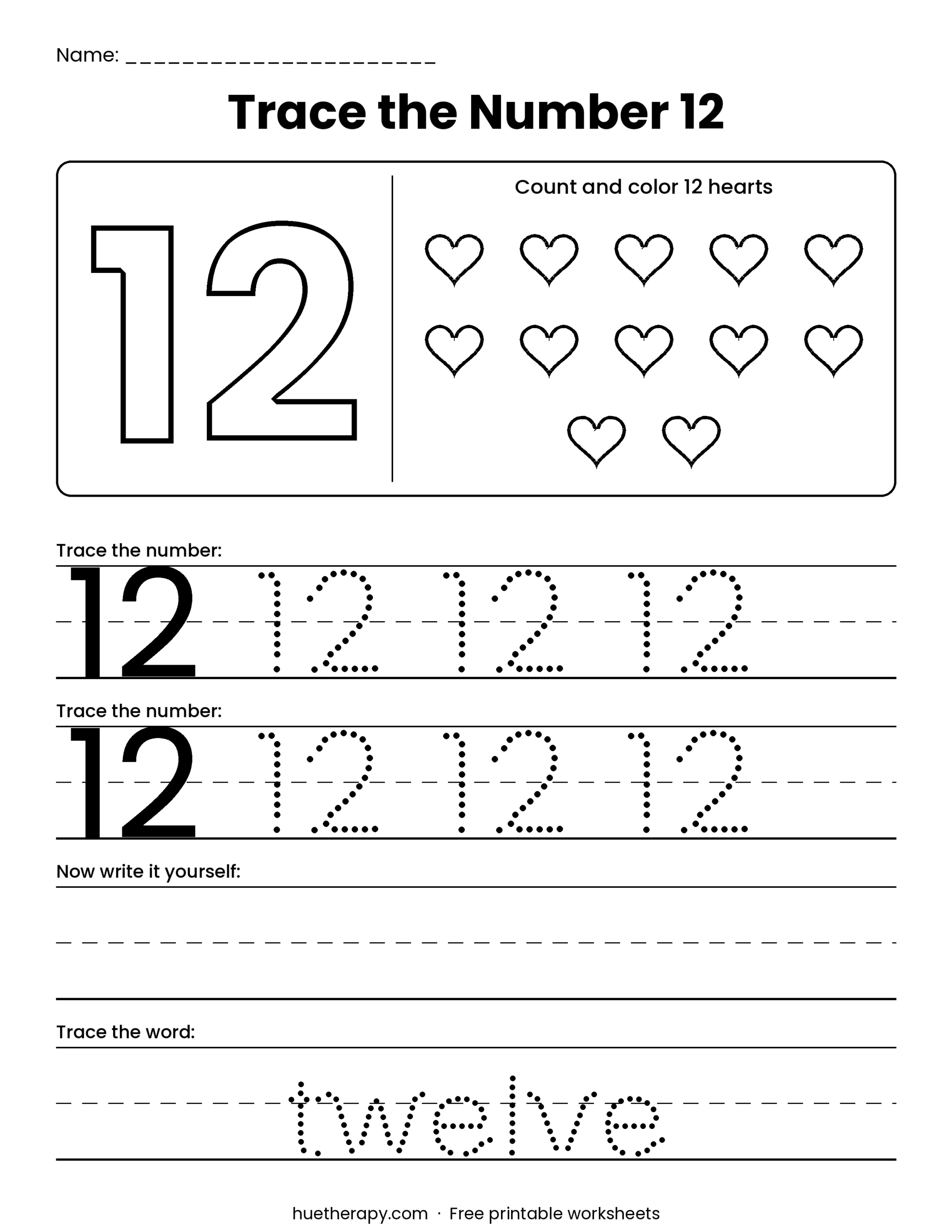
Number 12 — twelve. A 1 and a swan-curved 2 to color, plus twelve hearts arranged five, five, and two. Kids trace 12 down two rows, write it on their own, and trace the word twelve.
Twelve pairs the easy straight 1 with the swan-curved 2, so it recycles two shapes kids already know. Saying the digits as they are written — one, two — keeps the order straight. The twelve hearts are arranged five, five, and two, a layout that quietly teaches counting past ten as a full group of ten plus two extra.
Extension: twelve is a dozen, the number eggs come in, so draw an egg carton in the margin and put a heart in each of its twelve spots. Then count the numbers on a clock from 1 to 12 and finish back at the top — twelve is where the clock starts over.
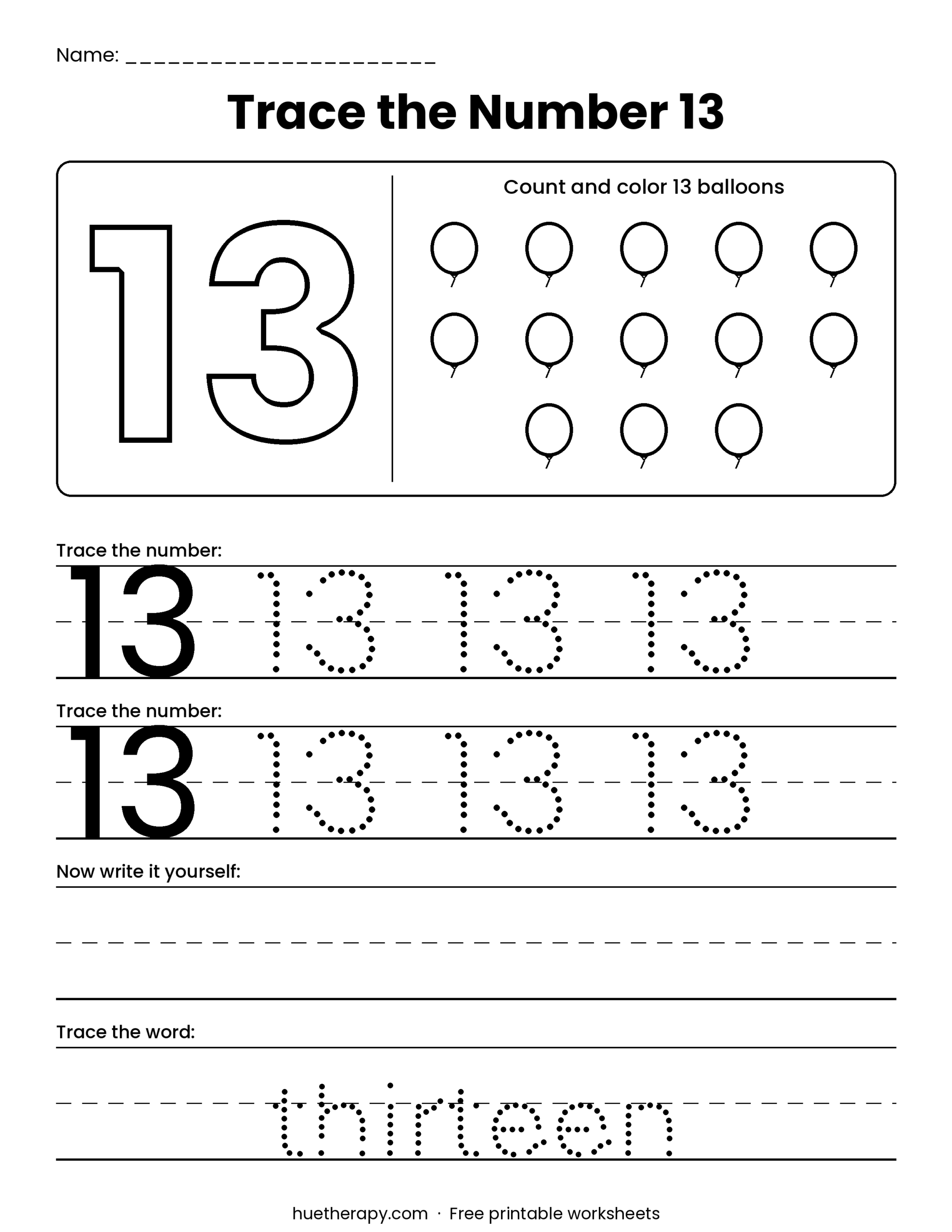
Number 13 — thirteen. The 1 meets the double-curved 3, and thirteen balloons — five, five, and three — fill the count panel. Two tracing rows, one solo row, and the word thirteen traced at the bottom.
Thirteen keeps the straight 1 and adds the double-curved 3. Saying one, three while tracing keeps the teen pattern musical: every number from here to 19 starts with that same 1. Thirteen balloons line up five, five, and three, and coloring the last row of three a different color makes the ten-and-three structure easy to see.
Extension: bakeries call thirteen a baker's dozen, so draw one bonus balloon floating above the others and color it gold. Then count thirteen stairs, thirteen tiles, or thirteen books — and draw a tiny bunch of thirteen balloons in the margin, strings and all.
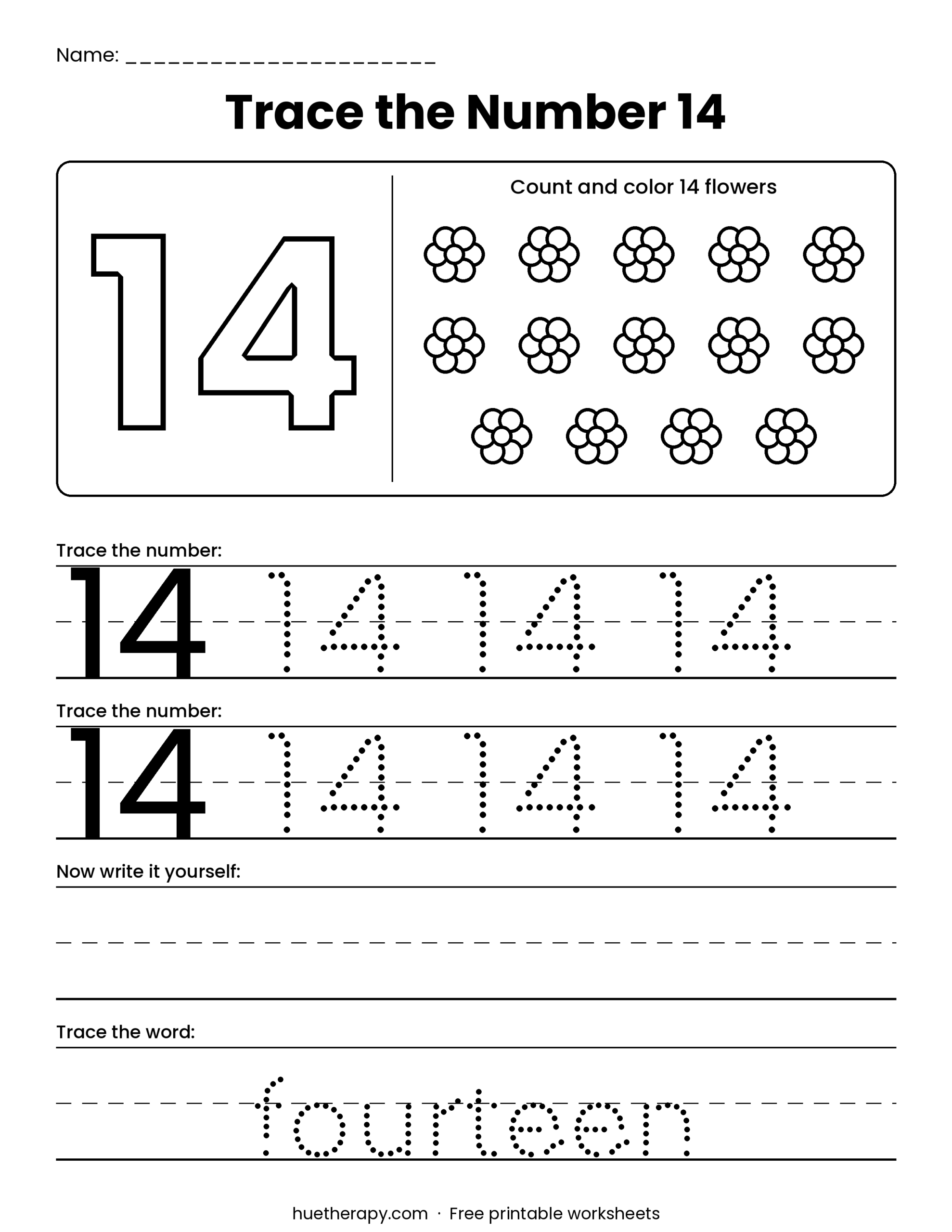
Number 14 — fourteen. A straight 1 and a sharp-angled 4 to color, with fourteen flowers in rows of five, five, and four. Trace 14 twice, write it yourself, and trace the word fourteen.
Fourteen joins the straight 1 to the all-angles 4 — one simple start, one sharp finish. The tracing rows give the 4's three strokes plenty of practice at this larger scale. Below, fourteen flowers sit in rows of five, five, and four; coloring the first two rows one color and the last row another shows ten and four more at a glance.
Extension: fourteen is two weeks of days, so count two rows on a calendar and land on the same weekday two weeks later. Then draw fourteen more flowers in the margin in two bunches of seven — a bouquet on each side of the page to count by sevens.
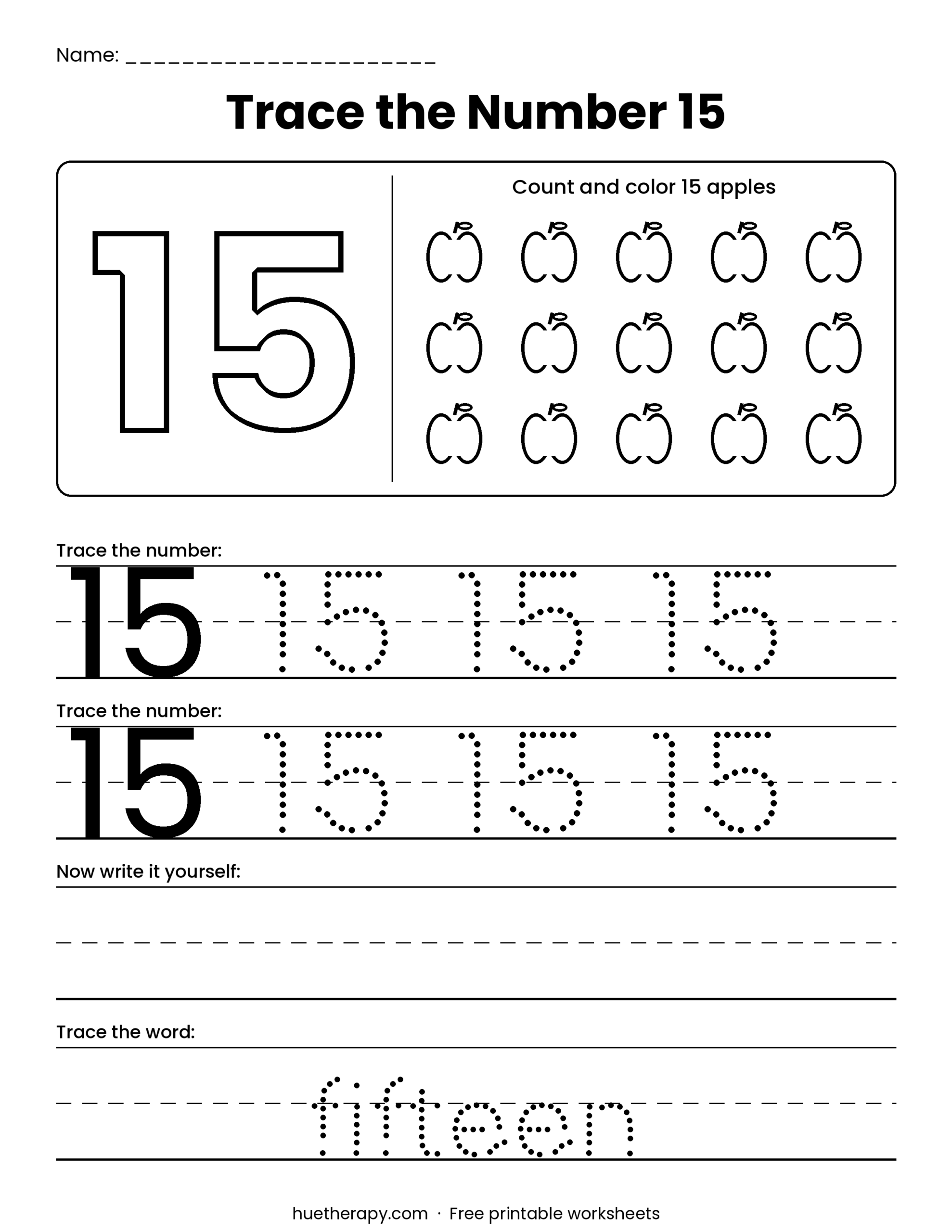
Number 15 — fifteen. The flat-topped 5 follows the 1, and fifteen apples fill three complete rows of five — the set's best count-by-fives sheet. Two tracing rows, the solo row, and the word fifteen.
Fifteen is the flat-topped 5 after the 1, and it marks the halfway point of the teens. The 5's hat, down, and around chant still works in second place. Fifteen apples fill three complete rows of five, the cleanest counting-by-fives picture in the whole set: 5, 10, 15, with no leftovers at all to confuse the count.
Extension: count by fives out loud using the rows — 5, 10, 15 — then keep going on fingers to 20 and 25. Draw fifteen more apples scattered under an apple tree in the margin, and count the full orchard: the two fifteens together make thirty.
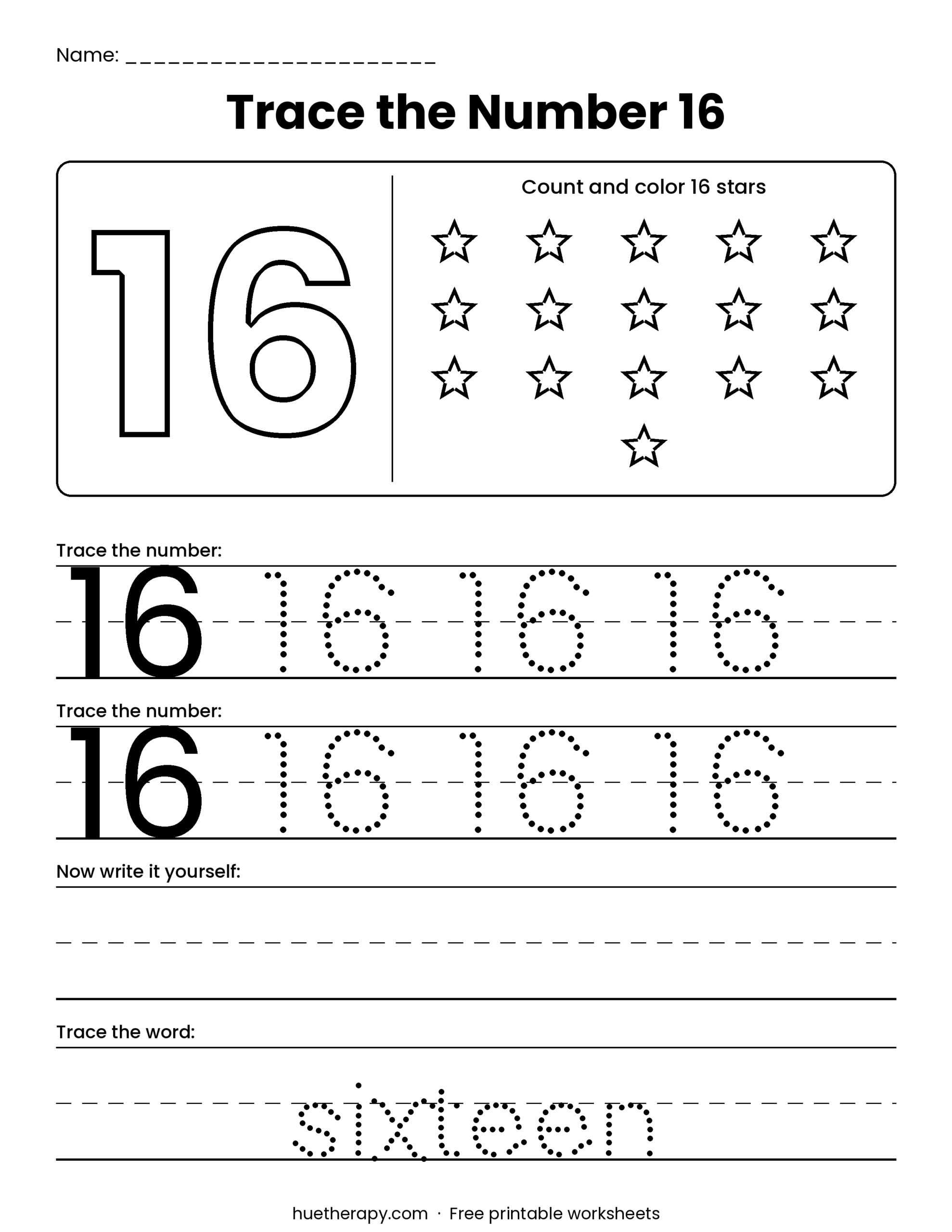
Number 16 — sixteen. The loopy 6 returns behind the 1, with sixteen stars in rows of five, five, five, and one. Trace 16 down the dotted rows, write it alone, and trace the word sixteen.
Sixteen brings back the loopy 6 behind the 1, and the old rule settles it: loop at the bottom means 6, even in a teen number. Sixteen stars are laid out five, five, five, and one, so the count naturally breaks into fifteen and one more — a useful stepping stone on the way up to twenty.
Extension: line up sixteen small things — bottle caps, coins, or crayons — in rows like the panel, then sweep them into a pile and count again to prove sixteen is sixteen however they sit. Draw one more star in the margin: sixteen plus one sets up seventeen.
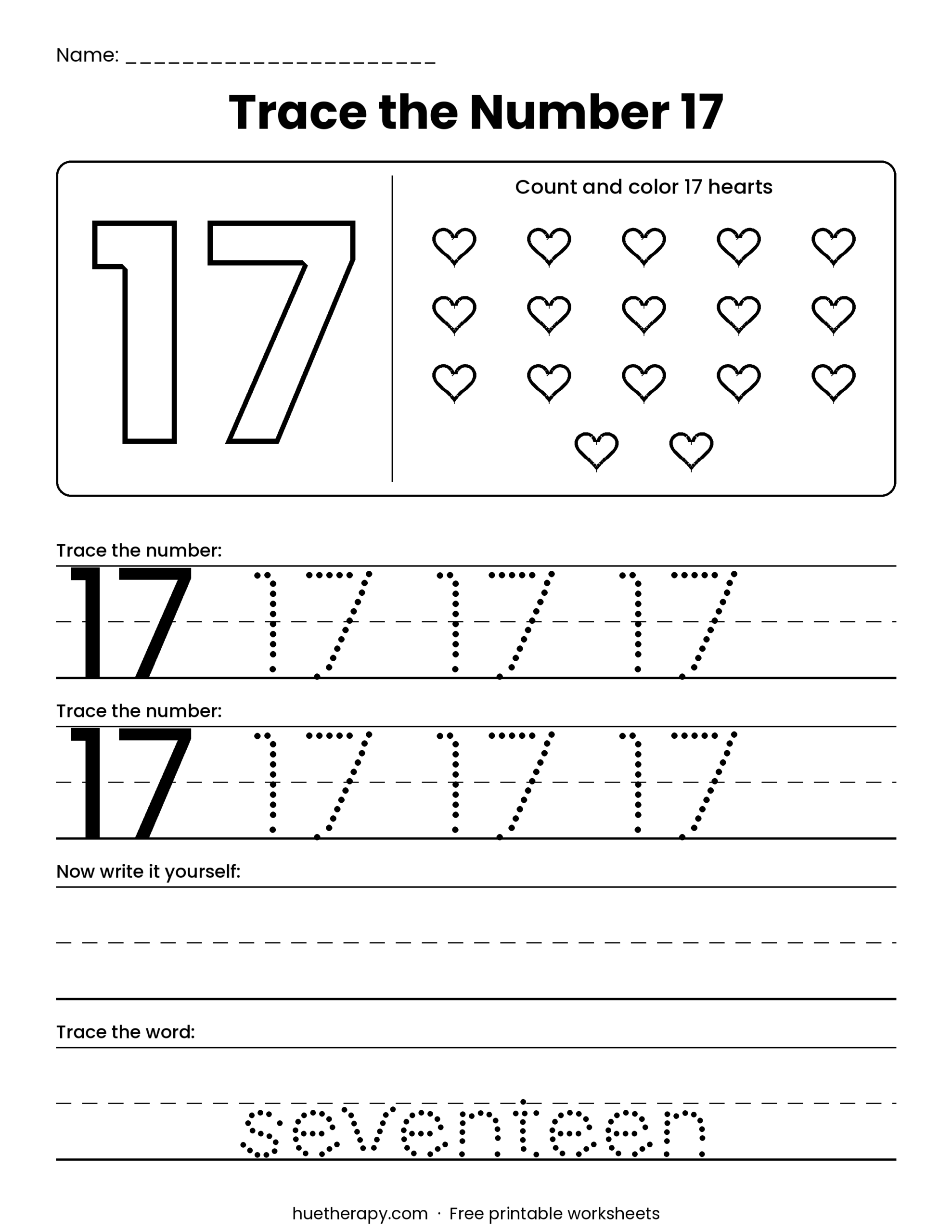
Number 17 — seventeen. The all-straight-lines teen — a 1 and a 7 — with seventeen hearts in three rows of five plus two. Trace, write it yourself, and trace the word seventeen to finish.
Seventeen is the all-straight-lines teen: a 1 followed by a 7, just flat tops and diagonal slides, with no curves anywhere. It is a restful sheet after the loopy 16 and sets up the curvy 18. Seventeen hearts sit in rows of five, five, five, and two — three full rows and a small remainder that keeps the count honest past fifteen.
Extension: play a counting scavenger hunt — find seventeen of something in the room, like seventeen books, chairs, or floor tiles. Then draw seventeen hearts as a bunting banner across the top margin of a blank page, counting each heart as it is hung.
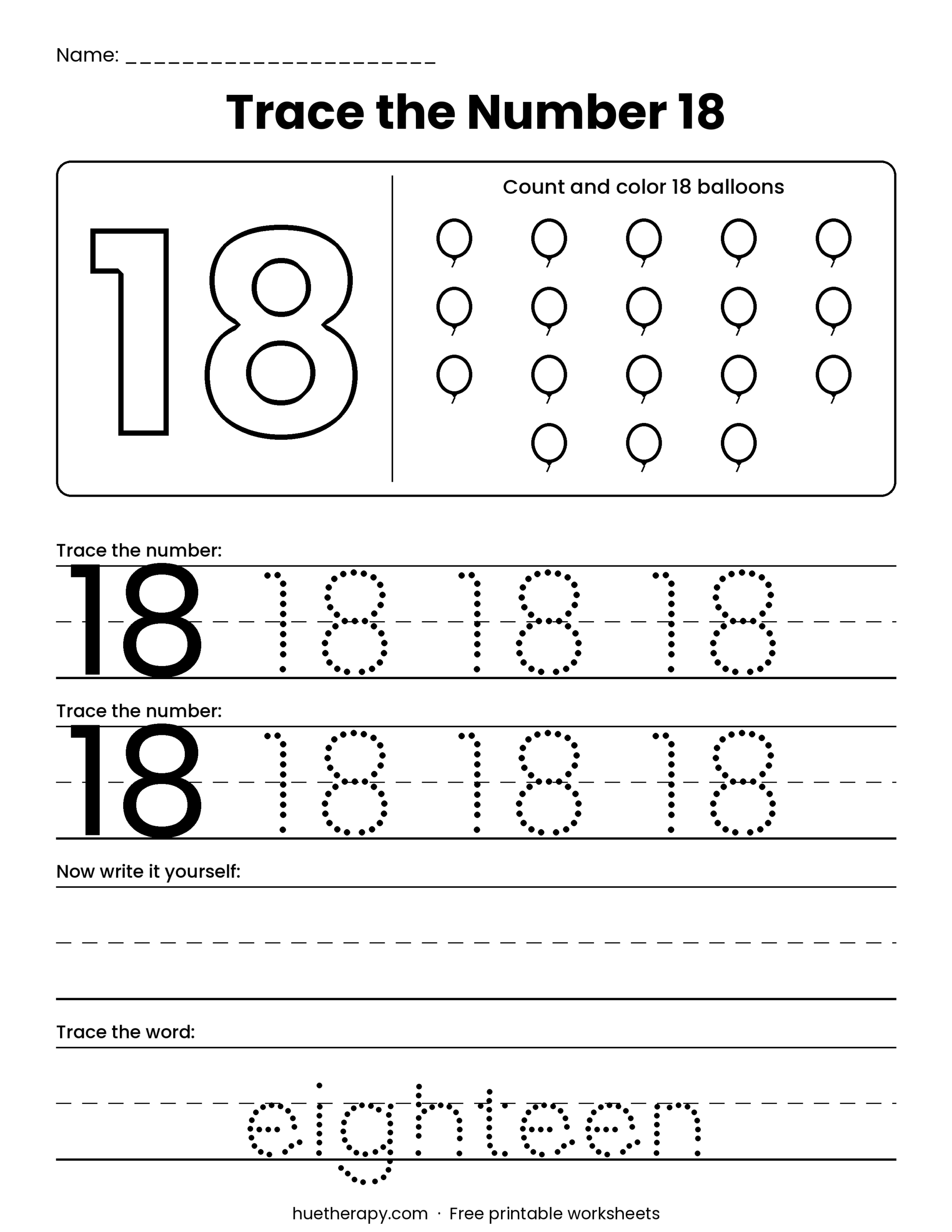
Number 18 — eighteen. The tricky snowman 8 gets another outing after the 1, with eighteen balloons in rows of five, five, five, and three. Two dotted tracing rows, the free row, and the word eighteen.
Eighteen saves the hardest digit for near the end: the snowman 8, written after an easy straight 1. All the 8 practice from earlier in the set pays off here. The eighteen balloons are arranged five, five, five, and three, and coloring each row its own color turns one long count into four short, easy ones.
Extension: count eighteen steps down the hallway or eighteen seconds of holding a silly pose. Then draw eighteen balloon strings in the margin tied to one big ribbon, and count them in rows like the sheet does — five, ten, fifteen, and three more makes eighteen.
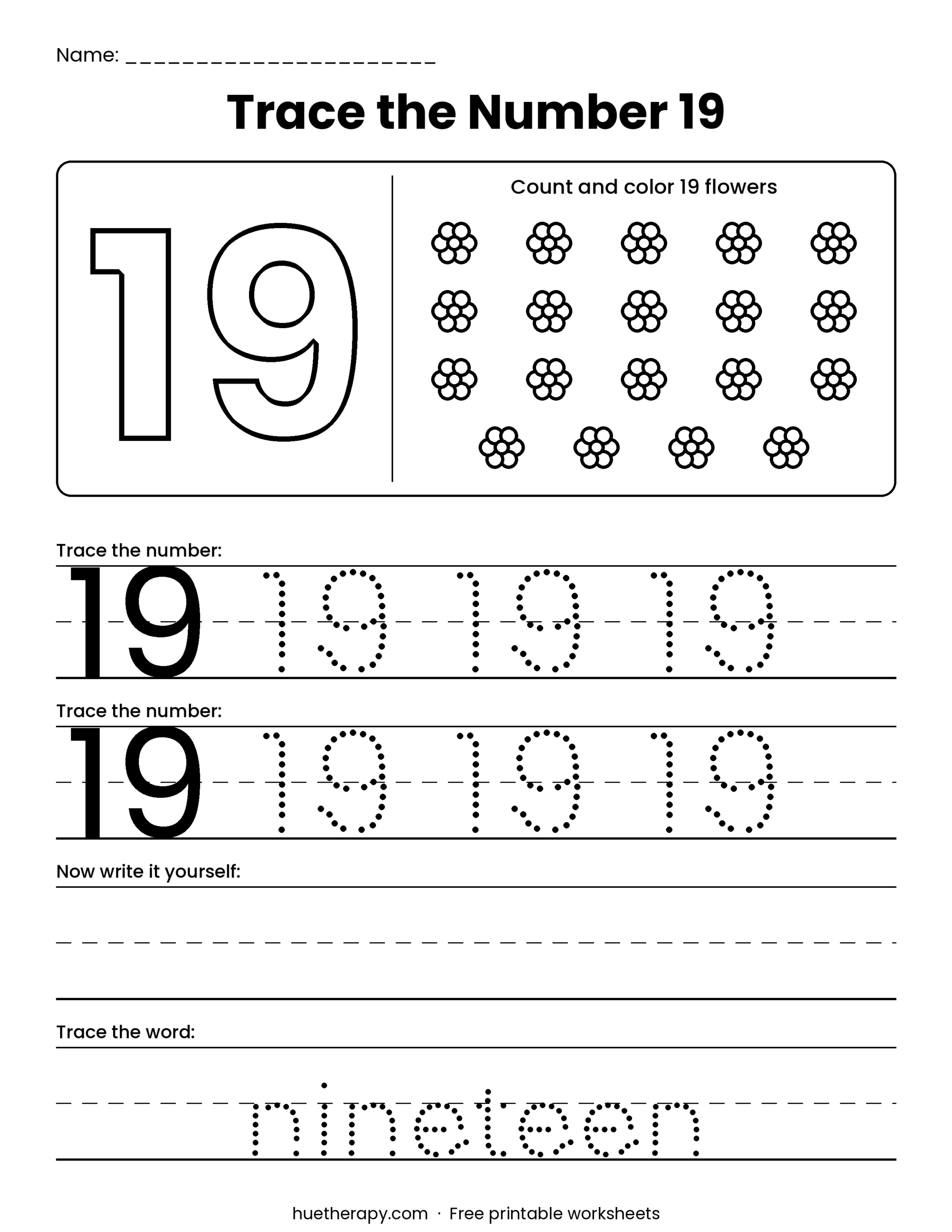
Number 19 — nineteen. The last teen pairs the 1 with a circle-topped 9, and nineteen flowers fill three rows of five plus four. Trace 19, write it on your own, and trace the word nineteen.
Nineteen is the last teen: a 1 and then the circle-topped 9, flipped opposite its old partner 6. Loop on top means 9 — the rule now works in both directions. Nineteen flowers fill rows of five, five, five, and four; the count lands one short of a full fourth row, which builds real anticipation for twenty.
Extension: ask the cliffhanger question — what comes after nineteen? Then draw the one missing flower that would complete the last row of five, and count the whole garden: twenty flowers, which is exactly where the final sheet of the set begins.
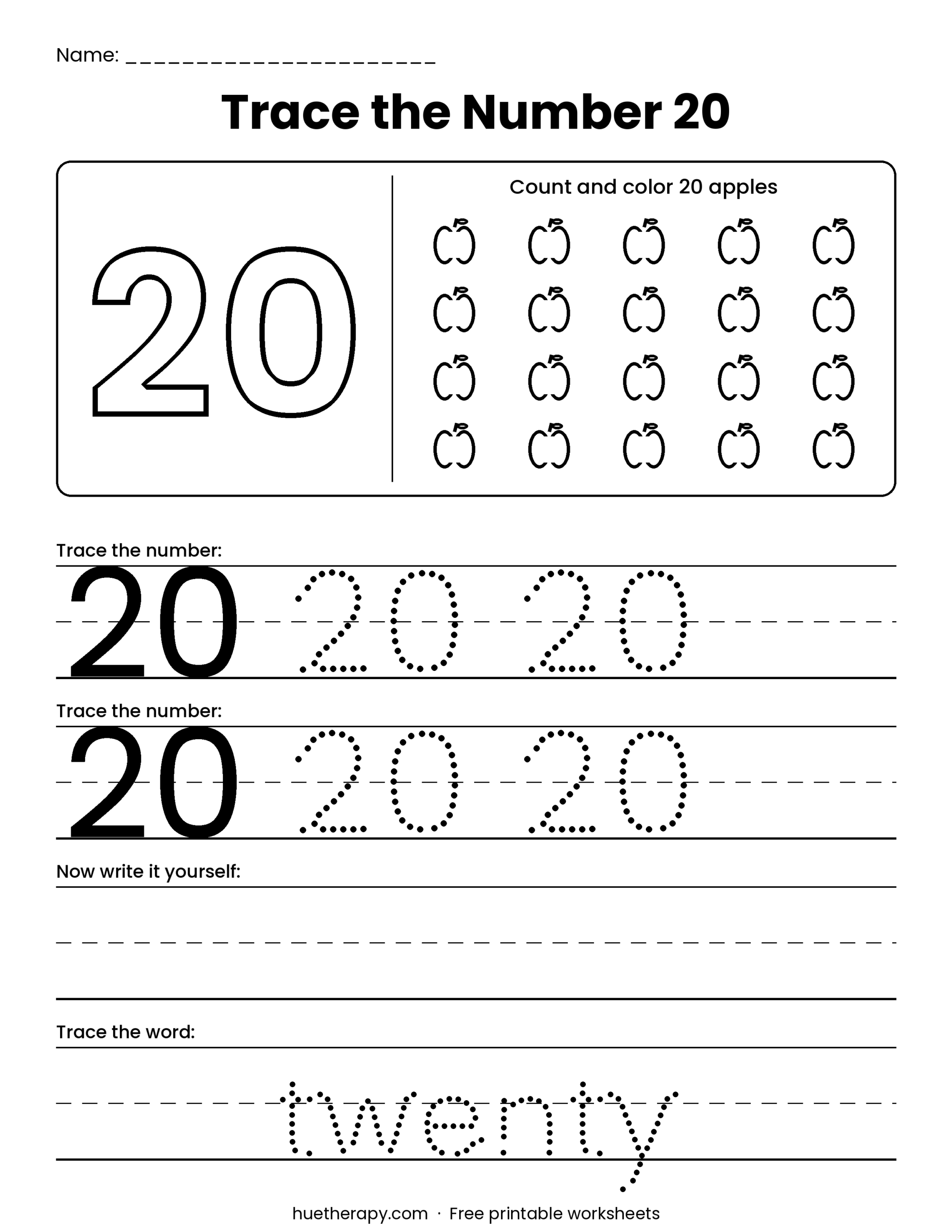
Number 20 — twenty. The finish line: a 2 and a 0 built from two full tens, with twenty apples in four complete rows of five. Trace 20 down both rows, write it solo, and trace the word twenty.
Twenty is the finish line: a swan-curved 2 and a round 0, the first number built from two full tens. The 0 needs a full, closed oval so it does not shrink next to the 2. Twenty apples fill four complete rows of five — count them by fives (5, 10, 15, 20) or by tens (10, 20) for the fastest finish in the set.
Extension: celebrate with the full count — say every number from 1 to 20 out loud, using this sheet and the earlier ones as a number line. Then draw the biggest apple tree you can in the margin and hang twenty apples on it, counting each one as it goes on the branches.
Tips for Using These Worksheets
- Start with 1–5: new writers do best with the first five sheets, where counting stays on one hand. Add a few numbers at a time as each one is mastered, rather than printing the whole stack at once.
- Make them reusable: slip a sheet into a page protector or laminate it and use dry-erase markers — perfect for math centers and morning tubs, and kids can practice the same number all week.
- Thick tools for new grips: short, chunky crayons and thick pencils are easier for small hands to control than standard pencils, and they make the dotted lines easier to follow.
- Count out loud together: say each number as it is traced, and count the pictures one by one, touching each one — hearing, seeing, and writing the number at the same time makes it stick.
- Print only what is needed: every sheet stands alone, so print just the numbers a child is working on, or run the whole set as a workbook for the week.
FAQ
How do I print these worksheets?
Each worksheet has its own page with Download and Print buttons. Print a single sheet for the number a child is working on, or work through the pages in order to print the full 1–20 set as a workbook. No sign-up or download bundle needed.
Are they free for classroom use?
Yes — the worksheets are free for classroom, homeschool, and home use. Print as many copies as your class needs for morning work, math centers, homework, or sub plans.
What size paper do the worksheets print on?
US Letter (8.5 x 11 inches) at 100% scale — every sheet is designed as one full page. A4 also works with fit-to-page switched on.
What ages and grades are these for?
Preschool through early first grade, roughly ages 3 to 6. Numbers 1–10 suit preschool and new kindergarteners; the 11–20 sheets stretch kindergarten and first-grade practice, with counting panels arranged in rows of five.
Should kids do the sheets in order?
In order helps at first: each sheet adds just one more picture to count, and the numbers build on the shapes learned before. Once most numbers to 10 are solid, feel free to jump around — pull out the sheets for the numbers a child reverses or skips (the 6 and 9 pair, and 12 and 20, are common mix-ups) and give those extra practice on their own.
More Coloring Pages You'll Love
If you enjoyed these, try our Color Palette Generator, Flower Coloring Pages, Cat Coloring Pages, or Dog Coloring Pages next.
Reviewed by Lara Bennett — every coloring page in this post was checked for clean lines, clear difficulty, and print quality before publishing.