

Rockets, flying saucers, and deep-space cruisers — this set covers every kind of spaceship. Toddlers get chunky cartoon rockets with big windows, while older kids get panel-lined cruisers with engines, antennas, and starry backgrounds.
About Spaceships
A real spaceship is mostly fuel tank. Rockets need enormous power to escape Earth’s gravity, so the tall cylindrical body is really a giant tank of fuel and oxidizer with engines at the bottom and a much smaller crew cabin or cargo area at the top. Ships built for orbit, like the space station, do not need to be sleek at all — with no air in space, there is nothing to streamline against, so they grow solar panel wings and antennas in every direction. Astronauts live in the small part; most of the vehicle exists to feed the engines.
That is why the ships in this collection look so different from each other. Pointed rockets are shaped to punch through the atmosphere on launch day. Blunt capsules are shaped to survive the heat of falling back through that air. Saucers and gunships belong to imagination and science fiction, where designers borrow the language of airplanes and submarines. As you color, notice the working parts repeating from ship to ship: windows, panel lines, antennas, docking rings, and engines big enough to matter. The variety is a feature, not a mistake — every shape is an answer to a different problem.
Get new coloring pages sent to your inbox!
Sign up and get our free 10-page Printable Favorites pack.
All 13 Spaceship Coloring Pages
Scroll down to browse every page below, or use the Print button under any image to print just that page.
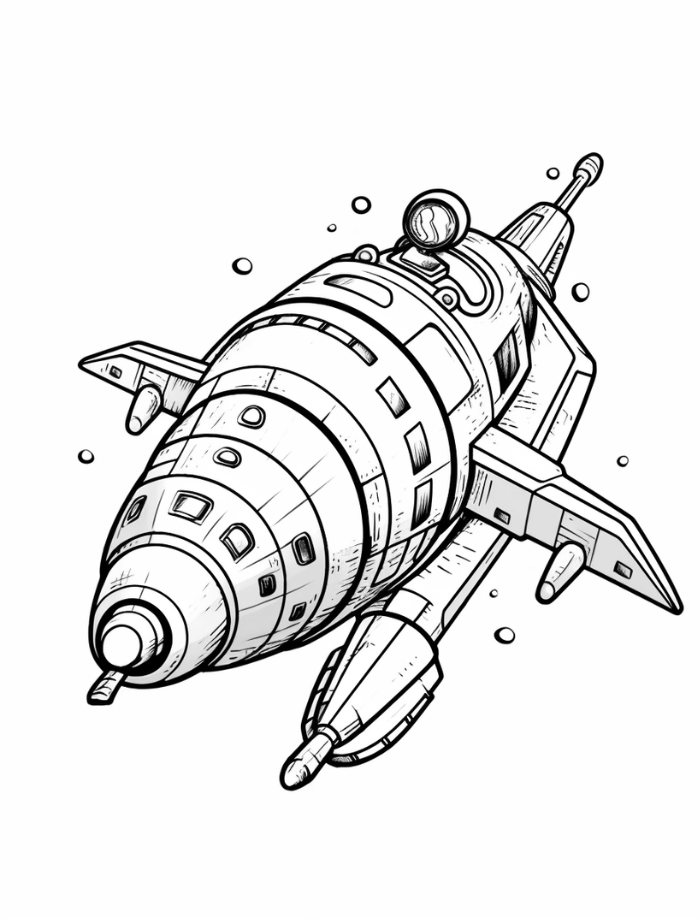
A detailed cylindrical spaceship covered in panels, windows, and antennas, angled as if cruising past. Detailed — best for teens and adults.
Give this ship a working-metal palette: layered grays for the hull, a few panels in a slightly bluer or warmer gray so the patchwork reads clearly, and warm amber in the windows to suggest a lit interior. Antennas look best with a bright accent, like signal red tips, against all that gray.
Metal cylinders fool the eye with one trick: keep a bright vertical highlight stripe down the center, darken both edges, and the flat page turns round. Work panel by panel with colored pencils, deepening the seams with a dark gray, and finish the antennas thin and precise — they are the finest lines on the page.

A retro flying saucer with a dome cockpit, round portholes, and a ring of lights, floating among stars. Medium — great for kids.
Go full retro with a silver-gray disc, a glass dome in pale teal or green, and the ring of lights alternating cherry red, gold, and cyan. Keep the stars small and golden so the saucer stays the biggest, brightest thing in its sky. A thin gold pinstripe along the disc's rim, if your hand is steady, finishes the vintage look.
Make each light glow by coloring a soft pale-yellow halo around it before you fill the bulb itself — the contrast sells the shine. The dome reads as glass if you leave a curved white streak across one side uncolored and shade only its lower edge. Leave the portholes' glass pale and bright so the lit ring stands apart from them.

A cartoon rocket blasting upward with twin engines and flames, surrounded by stars. Medium — great for kids.
Twin engines call for a classic scheme: white body, red nose cone and fins, and a sky-blue window band. Match the flames exactly on both sides — yellow at the throat, orange in the middle, red at the tips — so the rocket looks balanced as it climbs. One or two stars can echo the fin red as distant planets.
Flames layer from the inside out: pale yellow nearest the nozzle where the exhaust is hottest, building to deep orange at the edges. Color the background stars lightly or leave some white, because a busy background steals attention from the launch itself. If the two flames refuse to match, nobody minds — real exhaust never burns evenly either.

A large landing spacecraft touching down on an alien world with rocky towers and swirling clouds. Detailed — best for teens and adults.
Weathered ivory and tan suit a big landing craft — it has clearly been places. Set it against rust-red and ochre rock towers, and swirl the clouds in lavender-gray so the alien sky feels different from Earth's blue without turning garish. A ship this large reads best when its brightest whites sit high and its panel shadows gather below.
Distance does your shading for you: color the farthest rock towers pale and low-contrast, the nearest ones rich and dark, and the scene gains real depth. Darken the ship's belly where it would hang over its own shadow, and add light tan strokes at the base for dust kicked up by the landing.

A chubby cartoon rocket with a big round window and side boosters, ready for liftoff. Medium — great for kids.
Candy colors were made for this round little rocket: cherry red and clean white on the body, a sky-blue window with the glass left glossy, and boosters in soft gray. Big friendly shapes mean almost any bright combination works, so let a kid pick the scheme. The side boosters can share the nose color to tie the whole design together.
Roundness comes from shading the edges, not the middle. Run a slightly deeper shade of each color along both sides of the body and under the window, keep the center light, and the rocket puffs up like a balloon. A white dot left in the window makes instant glass. Short, light strokes keep marker edges from showing on such smooth curves.

A chunky sci-fi gunship with huge engines, cockpit windows, and panel details, flying through stars. Detailed — best for teens and adults.
Dress this gunship in serious colors: slate blue or military olive for the armor, deep teal glass for the cockpit windows, and a hot orange glow inside the engine bells. A few panels in gunmetal break up the bulk and make it look built, not cast. Keep the background stars sparse and pale so the dark hull owns the page.
Panel lines are a gift to patient colorists — go over them with a fine dark pencil after your base layers to restore every seam the marker softened. Add subtle weathering with short gray streaks trailing back from the engines, and keep the window glass the darkest, glossiest surface on the ship.

A sketch-style rocket with side boosters and a round window, streaking past stars. Medium — great for kids.
Silver body, orange boosters: the classic shuttle-era combination suits this sketchy rocket perfectly. Try gold stars and a deep navy wash behind it if you print on marker-safe paper, or leave the background white for a clean storybook launch. If you add a background, a single pale planet in one corner balances the diagonal flight path.
Match the artwork's energy instead of fighting it — colored pencil laid in visible strokes that follow the rocket's curve looks better here than flat, polished fills. Keep the two boosters mirror images in color so the design's symmetry survives your pencil work. The round window deserves the darkest outline and the clearest blue so the eye lands there first.

A cute symmetrical rocket with portholes, side pods, and a big front window, framed by stars. Medium — great for kids.
Symmetry is the whole design, so build the palette around pairs: white and teal body, navy portholes with a white shine dot in each, and side pods in a warm coral that appears nowhere else. Whatever you do to the left pod, do to the right. A soft gray shadow under the side pods helps them sit forward of the body.
Before coloring each new section, glance across the center line and copy the shade to its twin — it is much easier than balancing at the end. The big front window takes a gentle blue gradient, lightest at the top, and the stars can graduate in size, biggest nearest the rocket.

A rocket blasting off through puffy clouds with fiery exhaust and stars all around. Medium — great for kids.
A red-and-white rocket against white clouds needs a sky to fly through, so wash the background a real blue, light near the clouds and deeper at the top. The exhaust flame runs white-yellow at its core to orange at the edges, brighter than anything else on the page. Make the patch of sky behind the rocket the deepest blue of all — that is where the eye measures height.
Clouds stay light to work: leave their tops pure white and shade only the undersides with blue-gray, and they will billow in front of the blue sky. If your rocket's flame touches a cloud edge, a faint orange tint on that edge suggests reflected firelight. Work the sky around the clouds first and the clouds last, so no blue dust settles on their white tops.

A sleek rocket with three flame-trailing engines and motion lines, zooming past stars. Medium — great for kids.
Chrome is just gray with confidence: a silver-blue body, darker fins, and three flames that graduate white-yellow to orange in matching sequence. The motion lines work best in pale blue-gray, clearly lighter than the ship, so they read as speed rather than structure. One warm accent, like a red stripe or nose tip, keeps all that silver from turning cold.
Color the flames as three ribbons, each narrower and darker toward its tip, and keep their curves parallel so the thrust looks organized. A soft gray shadow down one side of the hull, following its length, turns the sleek shape three-dimensional without hiding the clean lines. Pencils beat markers for the hull here, because long smooth gradients are easier to control.

A retro rocket with rivets, a porthole window, and sunburst stars in the background. Medium — great for kids.
Think 1950s toy box: mint green or cream bodywork, red fins, and rivets picked out as tiny dark dots. The sunburst stars behind it alternate gold and orange rays, like a vintage poster announcing the future. The whole composition is a poster, so treat the background as part of the design rather than leftover space around the rocket.
Rivets reward a steady hand — dot each one the same dark gray with a sharp pencil or fine pen and the whole ship gains a built-from-metal feel. Keep your main fills flat and cheerful; heavy shading fights the retro style, which is all about clean shapes and optimism. Poster style rewards restraint everywhere else.

A cute rocket with a smiling face, round windows, and flame exhaust, surrounded by stars. Easy — best for toddlers.
Bright primaries are the whole point here: red top, blue or yellow body, and big simple shapes a toddler can fill without worrying about the lines. Give the smiling face rosy pink cheeks and leave the eye sparkles white. The flame can be the biggest, brightest shape on the page — yellow inside, orange outside, nothing fancy.
Chunky crayons and washable markers are the right tools — one bold color per part, no shading needed. If little hands want more to do, the surrounding stars can each be a different color, and the flame is a perfect first try at mixing yellow inside orange. Faces first is a good rule even for grown-up colorists, and toddlers can simply enjoy the big shapes.

A rocket with a big window flying past puffy clouds and motion lines. Medium — great for kids.
Turquoise and white make a fresh, friendly ship, and the big window wants to be the lightest blue on the page with the clouds reflected in it. The real clouds can carry soft gray-blue bottoms while the window stays clear and bright, separating glass from sky. Keep any extra color off the clouds so the window's blue reads as glass rather than sky.
Thin gray motion lines should stay whisper-light — press gently or use a pale pencil so they suggest speed without becoming stripes. A diagonal white band left uncolored across the window is the oldest glass trick in comics, and it works every time. Finish by darkening the rocket's outline on its lower side only, which grounds it against the bright background.
Coloring Tips for Spaceships
- Silver and gray colored pencils make great metal hulls — leave a white stripe uncolored for a shiny highlight.
- Color the flames yellow at the base, orange in the middle, and red at the tips for a realistic rocket exhaust.
- Fill the background deep navy or black and dot white stars around the ship — instant outer space.
- Give each window a light blue fill so it looks like glowing glass against the gray hull.
- For the detailed cruisers, use fine-tip markers or colored pencils; crayons work better on the chunky cartoon rockets.
FAQ
Can I use these in my classroom?
Yes — free for personal and classroom use.
What size paper should I print on?
US Letter (8.5x11) works best; A4 is fine with fit-to-page enabled. Each coloring page below has its own Download and Print buttons.
Why do some spaceships have wings and others do not?
Wings only help inside an atmosphere, where they create lift and let a craft glide home like an airplane, the way the space shuttle did. Ships that never land, or that land with parachutes and rockets, skip wings entirely — in the vacuum of space they would just be extra weight.
More Coloring Pages You'll Love
If you enjoyed these, try our Outer Space Coloring Pages, Airplane Coloring Pages, Truck Coloring Pages, or Motorcycle Coloring Pages next.

