

Tiger cubs steal this set: cartoon cubs with big eyes for little kids, plus a few realistic tigers with fine fur detail for older ones. Stripes make every page satisfying to color.
About Tigers
Tigers are the largest wild cats in the world, and the Amur tiger of far eastern Russia can weigh more than a grand piano. Most live alone in the forests, grasslands, and mangrove swamps of Asia, where Bengal tigers are the most numerous kind. Their orange coats might seem bright, but in dappled sunlight filtering through tall grass, that orange blends surprisingly well, helping a tiger slip quietly toward prey while its striped pattern breaks up its outline against shadows and stems. Tigers are also strong swimmers and often cool off in rivers.
No two tigers wear the same stripes. Each pattern is unique, like a fingerprint, and the stripes are printed on the skin as well as the fur. A tiger’s belly, cheeks, and the backs of its ears are paler, often white, with a white spot on each ear that cubs may follow through dim forest light. Cubs are born blind, stay with their mother for about two years, and learn to hunt by watching her. White tigers are not a separate kind, just a rare color variation. That variety gives colorists real choices on every page here.
Get new coloring pages sent to your inbox!
Sign up and get our free 10-page Printable Favorites pack.
All 12 Tiger Coloring Pages
Scroll down to browse every page below, or use the Print button under any image to print just that page.

A cute cartoon tiger cub with big eyes and bold black stripes sits smiling. Easy — best for toddlers.
Classic orange is the natural starting point here: a warm orange body, white on the muzzle and belly, and the bold stripes left deep black or colored in very dark brown. Keep the big eyes dark with a tiny white highlight, and add a soft pink nose. Because the shapes are large, one flat, cheerful color per area works beautifully.
Chunky crayons or washable markers suit this smiling cub best, since there is plenty of room inside each stripe and shape. Try the one-color-at-a-time game with a toddler: orange first, then stripes, then the face details last. Leave the eye highlights uncolored so the smile stays bright, and press lightly to keep the paper smooth for framing afterward.

A sweet tiger cub sits among a few leaves, its stripes and whiskers drawn in clean lines. Medium — great for kids.
Among the leaves, a slightly softer palette works well: golden orange for the cub, cream on the chest and muzzle, and two greens for the leaves, one fresh spring green and one deeper shade. That contrast helps the seated cub stand out from its leafy edges while the clean stripes stay crisp in dark brown or black for definition.
Whiskers are the detail to save for last, using a fine black pen or a sharply pointed pencil over the finished muzzle color. For the leaves, add a slightly darker line down the center of each one to suggest a fold. Keep your pencil strokes on the fur short and even, following the cub's seated, upright shape.

A tiger cub with softly shaded stripes sits in tall grass, looking up with gentle eyes. Medium — great for kids.
Tall grass gives this cub a natural frame, so color the blades in layered greens and yellows, richest at the bottom and paler near the top. Give the cub itself a warm orange coat with softly shaded stripes in charcoal or dark brown, a white muzzle, and gentle amber or dark brown eyes lifted toward the top of the page.
Soft shading is already suggested in the stripes, so build it gradually with colored pencils instead of pressing hard with markers. Leave a few grass blades in front paler than those behind to create depth, and you can draw in one small butterfly above the grass for the cub to watch, keeping it light so the gentle expression stays central.

A lifelike tiger cub with fine fur detail and delicate stripes sits on a rock. Detailed — best for teens and adults.
For this lifelike cub, work in true tiger tones: burnt orange over the back, fading to cream on the belly and inner legs, with delicate stripes in near-black. The rock beneath it reads best in cool grays with a hint of brown, because that cool base makes the warm fur glow. Keep the eyes amber with careful dark pupils.
Fine fur detail rewards short, layered pencil strokes that follow the direction the coat grows, especially around the cheeks and shoulders. Build shadow under the cub where it meets the rock, and leave the lightest fur almost white on the chest. A soft gray smudge along the rock's edge gives it weight without stealing attention from the face.

A tiger cub peers out from between large jungle leaves, its striped coat finely detailed. Detailed — best for teens and adults.
Jungle leaves call for deep, varied greens, from emerald in shadow to yellow-green where light would strike the edges. Let the cub peering between them carry the warm colors: rich orange fur, a pale muzzle, and finely detailed stripes in black-brown. Keeping the leaves slightly darker on one side makes the bright face feel as if it is emerging forward.
Layering is the skill this page teaches: color each large leaf in sections, darkest near its base and lightest at the tip. Use a white pencil or gel pen to sharpen tiny highlights on the cub's eyes and nose at the very end. Avoid outlining everything in black, since the fine coat detail already gives the hidden cub plenty of definition.
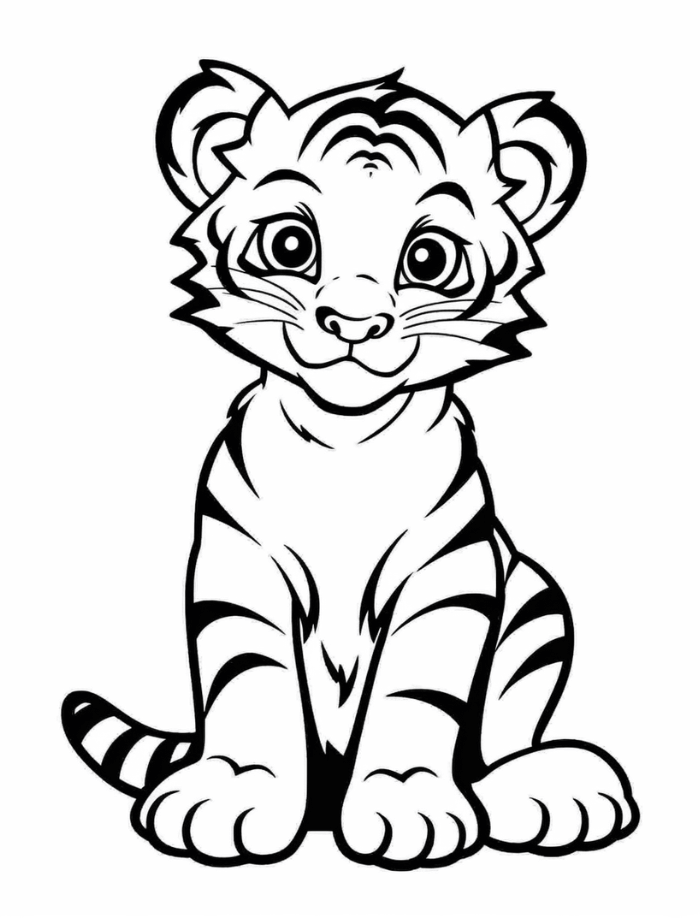
A bold cartoon tiger cub with thick outlines and simple stripes sits facing forward. Easy — best for toddlers.
Facing forward, this bold cub is made for poster colors: bright orange everywhere except the white muzzle, chest, and belly, with simple stripes filled solid black. Thick outlines forgive wobbly coloring, so even very young artists can stay mostly inside the shapes. A pink nose and dark round eyes finish the friendly, face-to-face greeting with cheerful, simple contrast.
Start with the biggest areas first, orange body and white patches, and leave the stripes for last so little hands can slow down there. Broad markers or chunky crayons both suit the thick lines. If a toddler wants a background, you can draw in a few big grass tufts at the bottom together, keeping them simple and well spaced.

A full-grown tiger with flowing stripe patterns stands in shallow water, ripples around its paws. Detailed — best for teens and adults.
Water changes an adult tiger's palette: keep the powerful body in deep orange and black, but cool everything below the paws with blue-grays and pale turquoise for the shallow water. The flowing stripe patterns should stay darkest above the waterline, while the ripples around the paws pick up broken touches of orange reflected from the coat above them.
Ripples look real when you color them as broken rings rather than solid bands, leaving thin white gaps where light catches the surface. Layer the tiger's shoulder and haunch shading in three tones before touching the water, so the animal feels solid and heavy. A final pale blue wash, applied lightly, unifies the wet lower half of the scene.

A chunky cartoon tiger cub with thick black stripes and a sweet face sits with its tail curled beside it. Easy — best for toddlers.
That curled tail is the signature shape here, so give it the same bright orange and thick black stripes as the chunky body, following its round curve all the way around. Keep the sweet face simple: white muzzle, soft pink nose, dark friendly eyes. Large, flat areas of cheerful color suit these round, chunky shapes better than fussy shading.
Round shapes invite a cozy finishing touch: shade just a little darker orange underneath the body and tail to help the cub sit firmly on the page. Toddlers can manage the big stripes with a wide marker, while an older helper adds the nose and eyes last. Try naming the cub when finished, and write it underneath together.

A realistic tiger cub with finely drawn stripes walks along a rock, a leafy branch behind it. Detailed — best for teens and adults.
Walking along the rock gives this cub a sense of direction, so let light fall consistently from one side: paler orange on the sunlit back, deeper tones under the belly and legs. The finely drawn stripes follow the stride, the rock stays gray-brown and muted, and the leafy branch behind can carry mid greens without competing with the moving cub.
Movement reads best when the paws and lower legs are shaded slightly darker than the body, grounding each step on the rock. Work the stripe edges with a sharp pencil, softening some and keeping others crisp, as real fur does. Add a faint cast shadow beneath the walking cub, stretched in the opposite direction from your chosen light.

A cheerful cartoon tiger cub with an open happy smile and bold stripes. Easy — best for toddlers.
An open happy smile deserves the sunniest palette in the set: vivid orange fur, a clean white muzzle and chest, and bold stripes in solid black. Color the inside of the smiling mouth soft pink or gentle red, keeping it lighter than the stripes. With shapes this simple and bold, bright flat color keeps the cheerful mood front and center.
Big, joyful pages like this are perfect first successes for toddlers, so choose chunky tools and celebrate finishing rather than neatness. Do the mouth and eyes near the end, when small hands have warmed up on the larger areas. You can draw in a simple sun or a few grass strokes around the cub afterward, as a shared finishing game.

A cartoon tiger cub sits face-forward with neat stripes and a friendly expression. Medium — great for kids.
Neat, even stripes make this face-forward cub a lesson in symmetry: match the stripe colors and coat shades on both sides, warm orange with a white muzzle and chest. Keep the friendly expression clear by coloring the eyes solid dark with small highlights, and use a slightly deeper orange along the outer edges to give the round face gentle shape.
Symmetry is easier if you color in pairs, finishing one stripe on the left and then its partner on the right before moving on. That rhythm keeps both sides balanced even if you take a break mid-page. Finish the muzzle last in the palest shade, so the friendly expression stays clear and bright when the page goes on display.

A bold tiger face in close-up with thick symmetrical stripes radiating across its cheeks and forehead. Medium — great for kids.
Close up, the face fills the page, so rich color matters: deep orange across the forehead and cheeks, paler cream around the lower face, and thick symmetrical stripes radiating outward in solid black. Keep the bands of orange between stripes evenly colored, with slightly deeper shading near the outer edges, so the bold pattern curves naturally around the tiger's head.
Radiating stripes reward a steady rhythm: work from the center outward, coloring matching stripes on each cheek in turn so the symmetry holds. Medium pages like this suit colored pencils or fine markers, which can reach the narrower points where stripes thin out. Add a soft darker edge along the very outside to frame the face like a portrait medallion.
Coloring Tips for Tigers
- Orange with black stripes is the classic, but white tigers (pale gray stripes on white) look striking too.
- Stripe order: color the whole body orange first, then add the black stripes on top — much easier than coloring around them.
- Eyes that pop: leave a tiny white highlight dot in each eye, and color the nose pink or dark brown.
- Palette ideas: (1) Bengal — orange, black stripes, white belly; (2) White tiger — light gray stripes on white with blue eyes; (3) Sunset — deep orange with reddish-brown stripes.
- Crayons or broad markers for the bold cartoon cubs; colored pencils for the realistic fur-detail tigers.
FAQ
Can I use these in my classroom?
Yes — free for personal and classroom use.
What size paper should I print on?
US Letter (8.5x11) works best; A4 is fine with fit-to-page enabled. Each coloring page below has its own Download and Print buttons.
How do I color tiger stripes so they look natural?
Keep stripes black or very dark brown, thinner where they meet the belly, and follow the curve of the body instead of drawing straight lines. Leave small gaps and varied lengths, since real stripes rarely join all the way around, and soften edges slightly on detailed pages rather than filling every stripe solid and flat.
More Coloring Pages You'll Love
If you enjoyed these, try our Cat Coloring Pages, Panda Coloring Pages, or Fox Coloring Pages next.


